



































×

iFour Logo

The Economic Impacts of Microsoft Foundry: Forrester Study

Published: Nov 16, 2026
Updated: Nov 16, 2026

Listening is fun too.

Straighten your back and cherish with coffee - PLAY !

  • play
  • pause
  • pause
The Economic Impacts of Microsoft Foundry: Forrester Study

Let's be honest... almost every business is adopting AI.

They're building copilots, automating business processes, accelerating decision-making, and looking for new ways to create value.

But one question that keeps coming up consistently is

How do you move from AI pilots and experiments to solutions that actually deliver measurable business results?

That's where things get challenging.

Because building an AI solution involves more than choosing a model.

You need the right infrastructure.

You need secure access to enterprise data.

You need governance, compliance, performance monitoring, and cost control.

And while the opportunity with AI is tremendous, its real journey can quickly become complex.

That's exactly where Microsoft Foundry comes in.

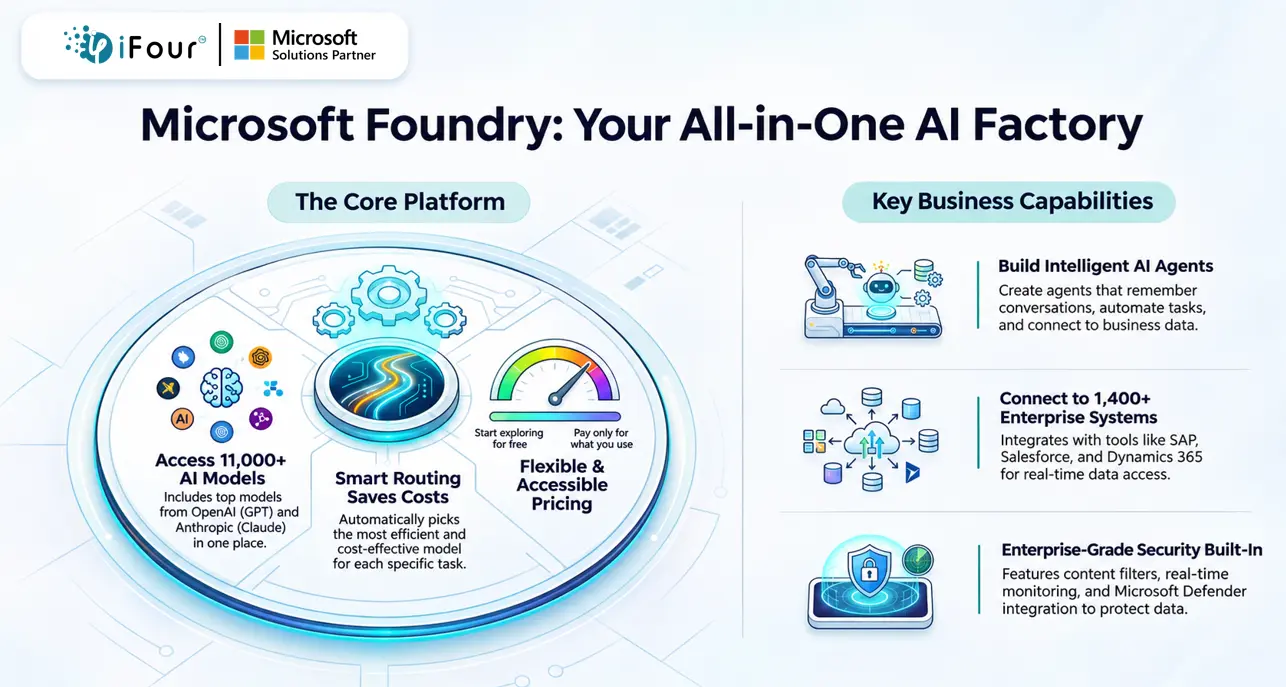
Microsoft Foundry capabilities

Image: Microsoft Foundry capabilities

How Enterprises Are Creating Value with Azure AI Foundry

When I came across the findings from Forrester Consulting's The Total Economic Impact of Microsoft Foundry study, one thing immediately stood out:

Everyone wants to build AI applications and agents, but very few firms actually know what the financial impact looks like at scale.

That's why studies like this matter.

Instead of talking only about Microsoft Foundry use cases, the report looks at something business leaders care about even more, i.e., the numbers behind it.

The study was commissioned by Microsoft, and it explores the following aspects of using Microsoft AI Foundry for building and managing AI agents and applications:

  • Potential financial benefits
  • Cost of implementation
  • Associated business risks

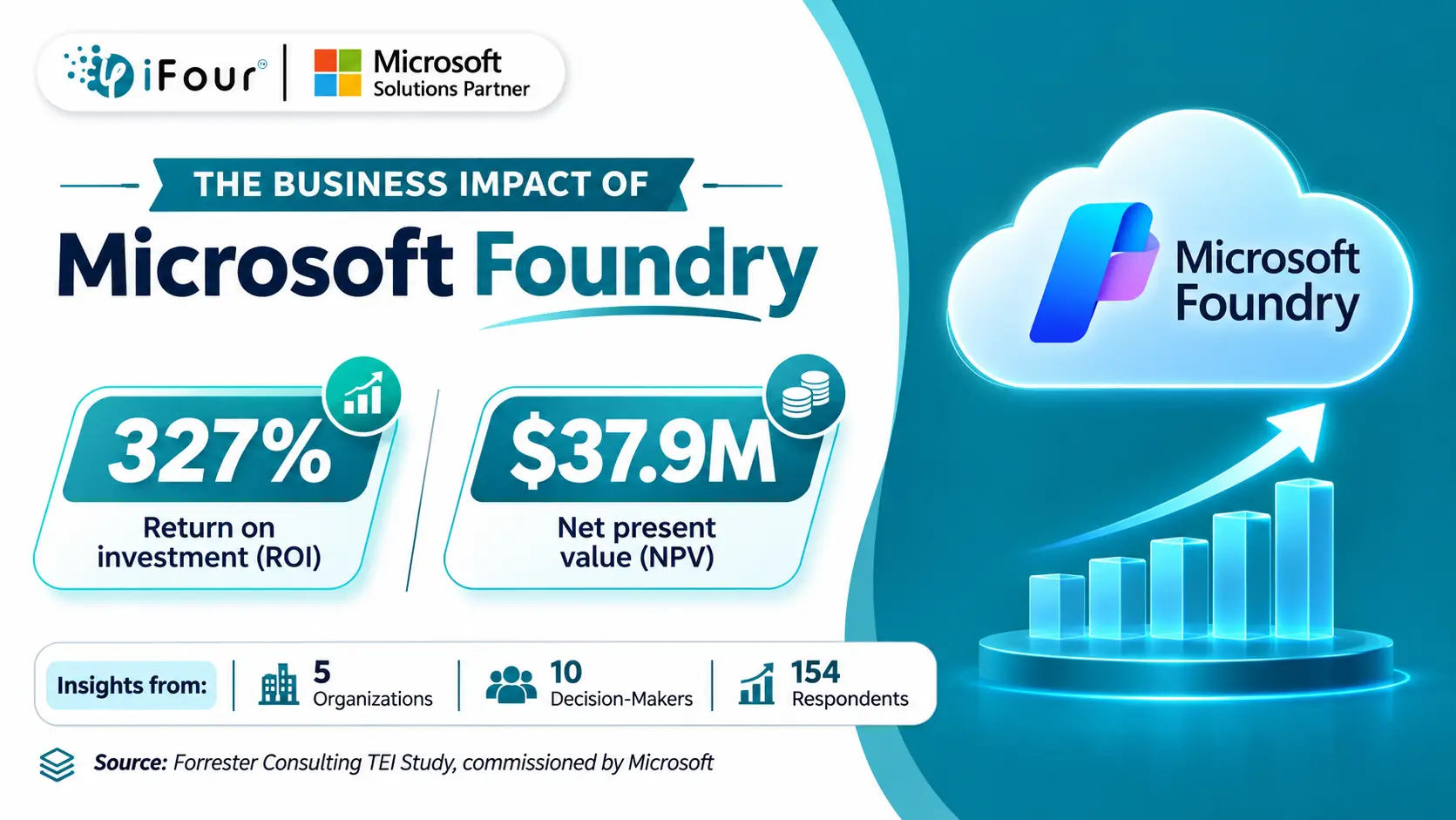
What caught my attention was the reported 327% return on investment (ROI) and $37.9 million net present value (NPV) achieved over three years for a representative composite organization.

Business Impact of Microsoft Foundry

Now, before anyone assumes these are guaranteed results, it's important to understand how the study was conducted.

These figures are based on interviews, survey responses, and financial modelling across participating firms. Every business has different goals, costs, and levels of AI adoption, so actual outcomes will naturally vary.

So, let's look beyond technical capabilities and ask a simple and practical question:

"What business value can we realistically expect?"

What's the economic impact of using Azure AI Foundry? And what can business leaders learn from it?

Let's examine the key findings and what they mean in practice.

Actionable solutions

Create Smarter Data Foundations

Drive better outcomes with Fabric Ontology consulting services

Key Findings From Forrester's Microsoft Foundry Study

Forrester interviewed 10 decision-makers across five organisations and surveyed 154 people with experience using Microsoft Foundry. It combined their experiences into a hypothetical composite organisation to model the potential financial impact.

The composite organisation represents a global business with $10 billion in annual revenue, 25,000 employees, and approximately 100 technical team members initially using Microsoft Foundry.

Here are the headline results of Microsoft Foundry for Enterprise impact.

Financial metric Three-year result
Return on investment (ROI) 327%
Net present value (NPV) $37.9 million
Present value of benefits $49.5 million
Present value of costs $11.6 million
Estimated payback period Under six months

Source: The Total Economic Impact of Microsoft Foundry, February 2026, executive summary and financial analysis.

These figures represent the study's risk-adjusted estimates for its composite organisation. They should not be interpreted as guaranteed savings or returns for every Microsoft Foundry customer.

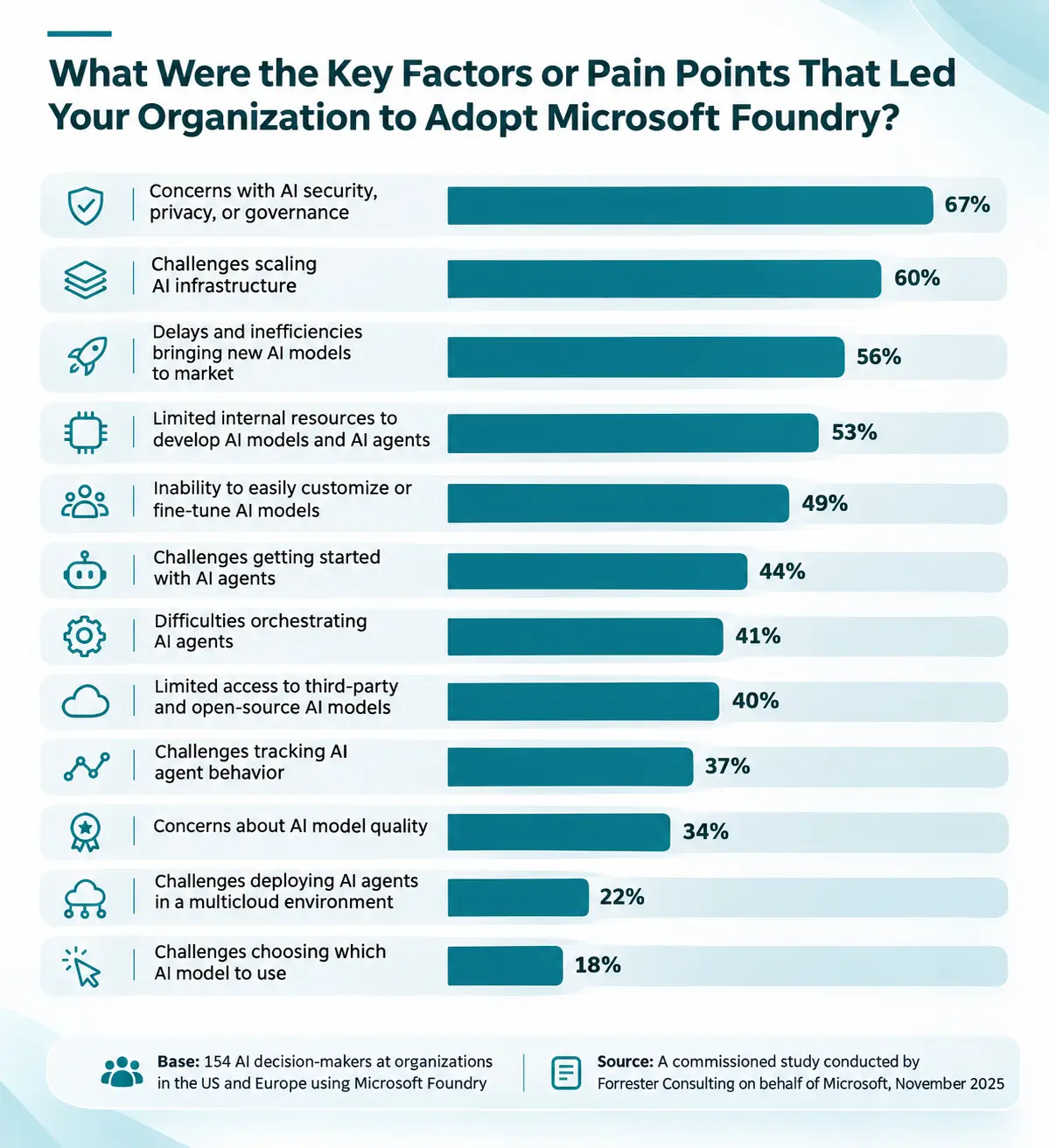
Microsoft Foundry Adoption Pain Points

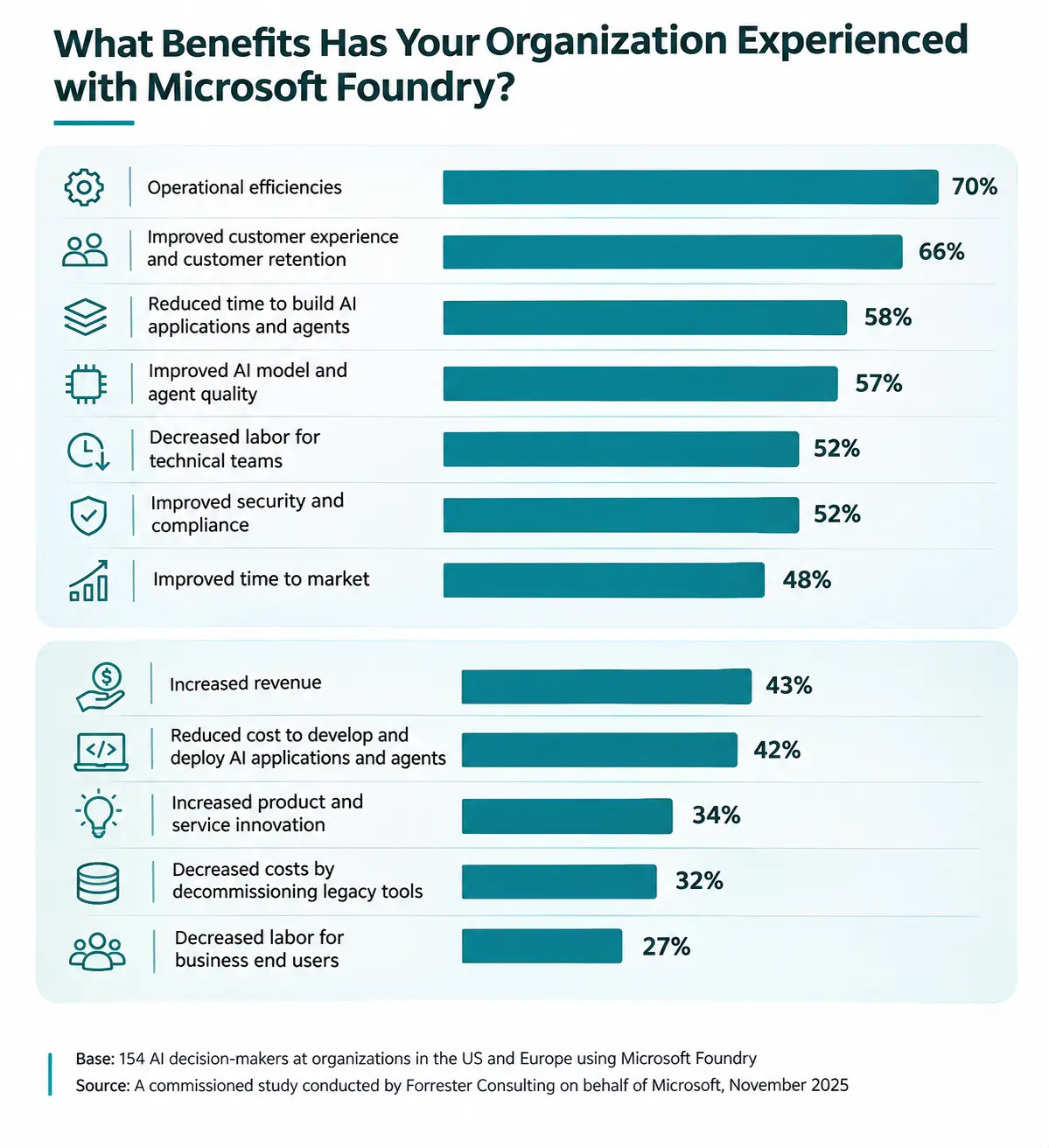
Source: Azure AI Foundry ROI for enterprises - Forrester survey

The main takeaway is that the business case for AI extends beyond the capabilities of an individual model.

It also depends on how efficiently an organisation can develop, deploy, govern, and use AI solutions.

Want to understand the potential impacts of Azure AI on your business? Connect with iFour for a tailored AI strategy assessment.

How Microsoft Foundry Impacts Business Growth, Productivity, and ROI

Beyond the technology itself, business leaders want to understand the real-world outcomes. Here's a look at the impact enterprises have reported from using Microsoft Foundry.

1. Faster AI development can improve technical team productivity

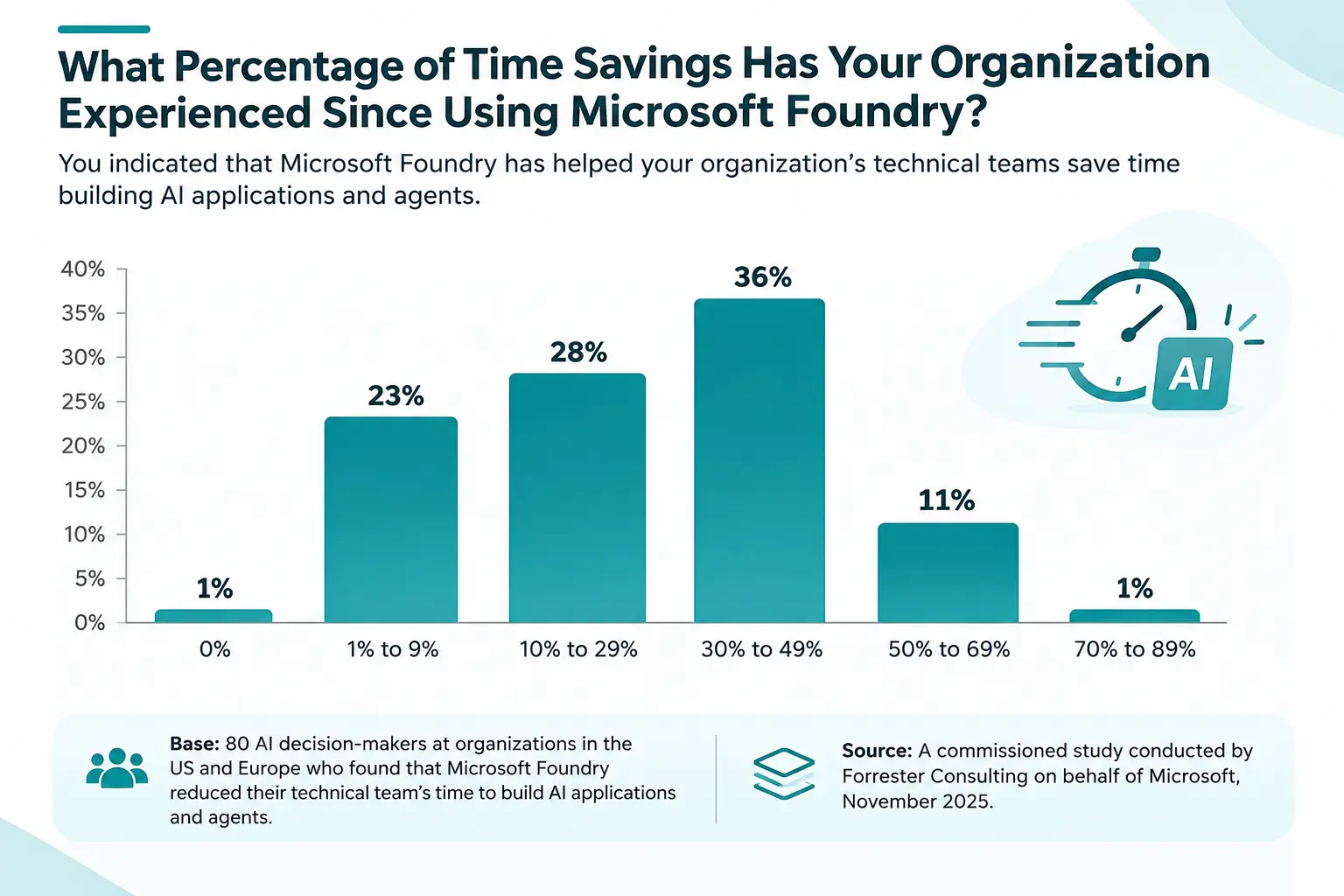
One of the largest quantified benefits in the study is improved technical team productivity.

Forrester estimates a three-year present value of approximately $15.7 million for this benefit. In its composite model, technical teams save 20% of their time in Year 1 and 35% by Year 2.

Why does this matter?

Developing an AI application often involves multiple activities, including:

  • Evaluating and selecting suitable AI models.

  • Connecting models to business data and applications.
  • Developing prompts, workflows, and agent logic.
  • Testing outputs and improving model performance.
  • Implementing security controls and monitoring.
  • Preparing applications for production deployment.

When these activities require teams to switch between disconnected tools and manage underlying infrastructure, development can become slower and more resource-intensive.

Microsoft Foundry brings model access, development capabilities, reusable templates, and other tools into a unified environment. This can reduce some of the overhead involved in building AI applications and agents.

Microsoft Foundry Adoption Pain Points

Real-World Azure AI ROI Example:

A leading financial services client recently approached iFour to build an AI-powered assistant that could help relationship managers work more efficiently and serve clients better.

The idea sounded simple: help advisors prepare better for client meetings.

But when we looked at the actual development process, most of the effort wasn't going into making the assistant smarter. It was going into evaluating AI models, connecting tools, managing infrastructure, and setting up monitoring.

That's the challenge with many AI projects today.

Teams want to focus on getting business value, but they often end up spending a large portion of their time stitching together technology.

A unified AI development platform like Azure AI Foundry can change that by bringing these components together, allowing AI developers to spend more time improving accuracy, relevance, and user experience.

Simplify complexity

Make AI Work Smarter

Drive results using AI LLM development & consulting

Key Learning for business leaders:

If your teams spend more time managing infrastructure than building products, there's likely room to unlock more innovation without adding more resources.

Microsoft Foundry Time Savings Survey

Image: The economics of Enterprise AI

2. AI-powered automation can help reduce operating expenses

The second major finding concerns operating efficiency.

Forrester estimates that streamlined operating expenses deliver a three-year present value of approximately $12.3 million in its composite model.

The report notes that around two-thirds of the AI applications and agents developed by the composite organisation focus on process automation.

This distinction matters. AI does not automatically reduce every business expense. The savings depend on which processes are affected, how frequently they occur, and whether the new workflows genuinely reduce effort or resource consumption.

Common opportunities include:

  • Handling repetitive data-processing tasks
  • Sorting and directing incoming requests to the right people
  • Pulling key details from documents automatically
  • Finding answers from internal knowledge sources
  • Responding to common customer questions
  • Keeping business workflows moving smoothly from one step to the next.

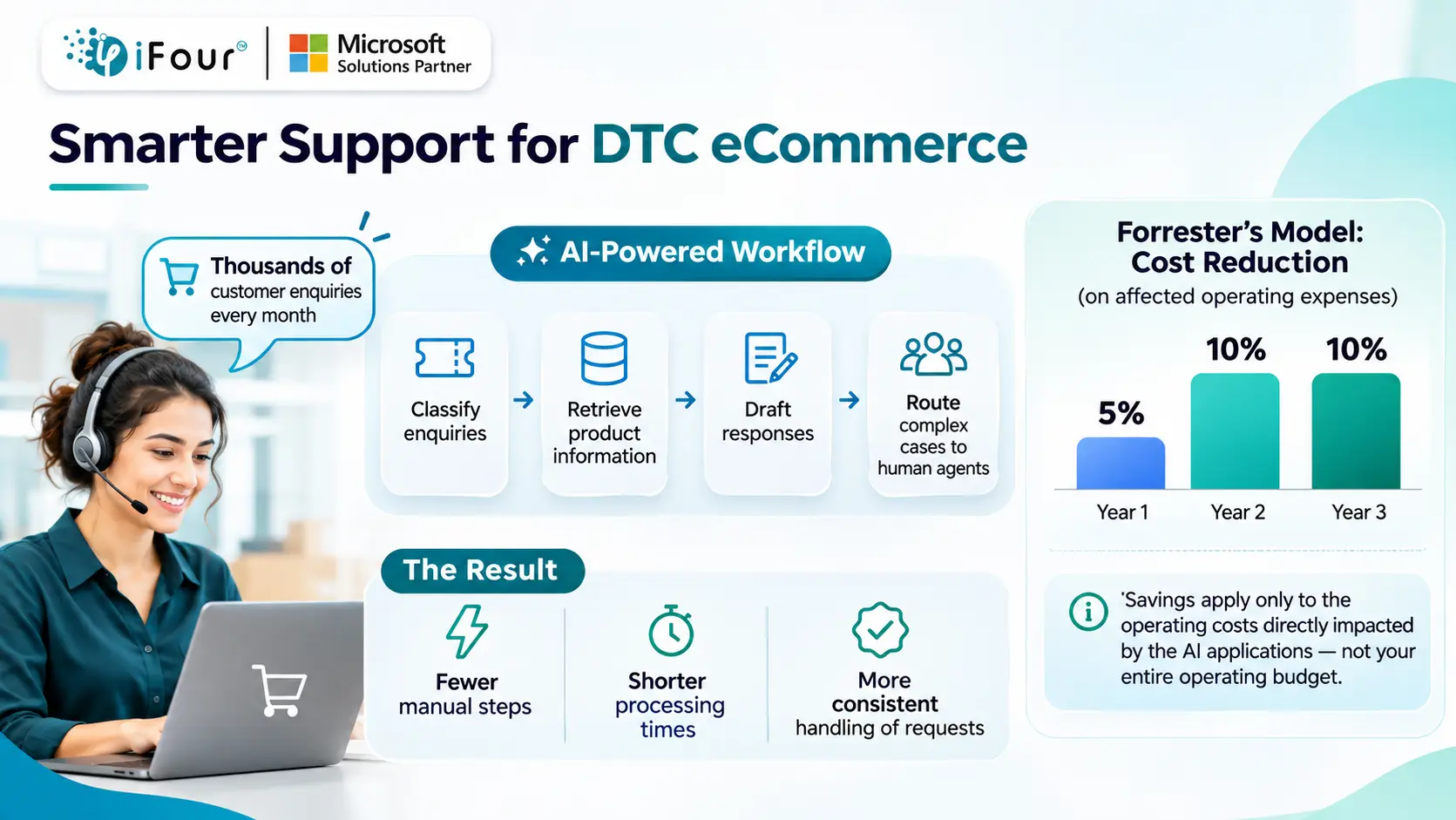
Azure AI in Business Example: Automating Customer Support Operations

An eCommerce DTC brand receives thousands of customer enquiries every month.

Its support team spends considerable time categorising tickets, retrieving product information, answering recurring questions, and directing requests to the right department.

An AI-powered workflow could classify incoming enquiries, retrieve relevant information, draft responses, and route complex cases to human agents.

The result could be fewer manual steps, shorter processing times, and more consistent handling of routine requests.

Forrester's composite model assumes that the AI applications affect only a portion of operating expenses. Within those affected categories, the model assumes a 5% reduction in Year 1, increasing to 10% in Years 2 and 3.

Smarter Support - DTC eCommerce

Image: Azure AI ROI Example

That is an important qualification: the report does not suggest that Microsoft Foundry reduces an organisation's entire operating budget by 10%.

Key learnings for business leaders:

Start with high-volume, repetitive workflows where the cost of manual effort is measurable. Track cost per transaction, handling time, error rates, and escalation rates before and after deployment.

Accelerate growth

Unlock Microsoft AI Value

Achieve more with Microsoft Copilot consulting

3. Faster time to market can create new revenue opportunities

And there's another benefit that's easy to overlook...

Speed.

Because when it comes to AI, developing faster isn't just about saving engineering time.

It's about getting value into the hands of customers sooner.

In fact, Forrester estimates that faster AI application and agent development can deliver approximately $12.3 million in value over three years.

But here's the important part...

This isn't just a cost-saving story.

It's a growth story.

When enterprises can launch AI-powered products faster, respond to market demands sooner, or bring new services to customers ahead of competitors, the impact goes far beyond development efficiency.

The opportunity isn't simply building AI faster.

It's turning that speed into revenue, market advantage, and business growth.

And that's where accelerated AI development starts creating measurable business value.

Business example: Launching an AI-enabled Service

KPN, an NL-based Telecommunications and IT services provider, launched an AI-powered reporting assistant for enterprise customers.

The product could summarise business data, answer questions in natural language, and help users identify trends without manually reviewing multiple reports.

If the company can develop and deploy the assistant more efficiently, it may be able to launch the offering earlier and begin validating customer demand sooner.

Earlier availability does not guarantee higher revenue. The product still needs to solve a genuine problem, deliver reliable results, and meet customer expectations. However, faster development can give the company more time to gather feedback, improve the service, and refine its commercial strategy.

Forrester's composite model estimates incremental profit by applying an assumed operating margin to the additional revenue associated with faster time to market. It does not treat every dollar of incremental revenue as profit.

Key Insights for business leaders:

Evaluate AI initiatives in terms of business outcomes, not just development milestones. Useful measures include time from idea to production, adoption rates, incremental revenue, customer engagement, and contribution margin.

4. AI assistants can improve employee productivity

Let's talk about another benefit that's often overlooked.

AI isn't just helping technical teams build faster.

It's helping employees across the business spend less time searching, switching between systems, and handling repetitive tasks.

According to Forrester, those productivity gains can create nearly $4.8 million in value over three years.

But that doesn't mean every hour saved becomes a dollar saved.

The real question is:

What happens with the time employees get back?

If that time is reinvested into customer service, innovation, collaboration, and higher-value work, the impact can be substantial.

That's when productivity improvements become meaningful business outcomes.

Actionable solutions

Deploy Smarter Digital Workers

Increase efficiency with AI Agent development services

Business example: Helping sales teams prepare for customer meetings

Now, let's make this practical.

Think about a sales representative getting ready for a customer meeting.

They need to review previous conversations.

Check product information.

Look up pricing.

And gather the right customer context.

That can mean jumping between multiple systems and spending valuable time searching for information.

But what if an AI assistant could bring all of that together?

By connecting to approved business data, AI can help answer routine questions, surface relevant information, and prepare employees with the context they need, when they need it.

And here's where the real value shows up...

Instead of spending time looking for information, employees can spend more time acting on it.

More time understanding customer needs.

More time building relationships.

More time delivering value.

In fact, the Forrester study highlights an example from a financial services enterprise where sales representatives save 20 to 30 minutes every day searching for information.

That's not just a productivity gain.

It's more time spent with clients and more opportunities to drive business outcomes.

Because ultimately, the goal of AI isn't simply to automate tasks.

It's to help people do their highest-value work more effectively.

And for many businesses, that's where some of the biggest returns come from.

Key learnings for business leaders:

Identify the activities that employees can perform more effectively with AI. Measure time saved, adoption, output quality, customer-facing time, and employee satisfaction.

5. Consolidating AI infrastructure can reduce existing costs

There's another area where enterprises can create value with AI...

And that's reducing the cost and complexity of building and managing AI solutions.

Because let's face it...

Building everything from scratch can be expensive.

Enterprises often have to invest in infrastructure, development tools, monitoring platforms, support resources, and the ongoing effort required to keep everything running smoothly.

According to Forrester, enterprises can realize approximately $4.3 million in value over three years through avoided infrastructure and services costs.

But here's the important distinction...

This isn't about eliminating costs altogether.

It's about simplifying the technology stack and reducing unnecessary spending.

By providing a common platform for AI development, deployment, and management, Microsoft Foundry can help firms reduce their dependencies on multiple tools, legacy infrastructure, and additional support resources.

That can mean fewer systems to manage, less operational overhead, and more focus on delivering business outcomes.

Of course, AI still requires investment.

There are implementation costs, platform costs, and ongoing maintenance considerations.

But for many enterprises, the opportunity lies in replacing complexity with a more streamlined approach.

And that's where Microsoft Foundry can help reduce both the operational burden and the cost of scaling AI.

Actionable solutions

Bridge Data And Agents

Accelerate automation using MCP server development services

Business example: Replacing a fragmented AI development stack

Suppose an organisation has separate services for model hosting, AI experimentation, deployment, and agent monitoring.

Its technical team spends time maintaining these components and resolving integration issues. As AI usage expands, infrastructure and support requirements also grow.

Moving suitable workloads to a consolidated platform could reduce duplication and simplify operations. The organisation could then retire redundant tools where their functions are no longer required.

The financial benefit would depend on the costs that can actually be removed, the migration effort, and the ongoing consumption charges associated with the new environment.

Learnings for business leaders:

Review existing AI infrastructure and service contracts before migrating. Identify overlapping capabilities, retirement opportunities, migration costs, and ongoing platform expenses.

6. Security, governance, and model choice matter to business value

Not every benefit in Forrester's study has a quantified dollar value.

The report also identifies security and compliance assurance, improved model quality, access to a broad set of AI models, and enhanced AI agent management as additional benefits.

These findings are relevant because enterprise AI requires more than a model that produces useful answers. Organisations also need to consider data access, privacy, model behaviour, security controls, and operational visibility.

The study's survey findings provide further context:

  • 67% identified concerns about AI security, privacy, or governance as a factor leading to adoption.
  • 60% reported challenges scaling AI infrastructure.
  • 56% identified delays and inefficiencies in bringing new AI models to market.
  • 75% agreed that Foundry enabled easier model grounding or integration with knowledge sources.
  • 55% agreed that it enabled improved AI model accuracy.

These are survey responses from people with experience using Microsoft Foundry, not universal industry benchmarks.

Business example: Building an internal knowledge assistant

Consider a company that wants employees to ask questions about policies, product documentation, and internal procedures.

A basic language model might generate plausible answers without consistently grounding them in the company's approved information.

A more complete implementation would connect the assistant to appropriate knowledge sources, control which information users can access, evaluate response quality, and monitor its behaviour.

Here's how Microsoft Foundry helps you with cost savings and growth:

Microsoft Foundry provides capabilities intended to support model development, grounding, safety, and governance. However, businesses still need to configure these capabilities correctly, manage access permissions, validate outputs, and establish accountability.

Accelerate growth

Launch Intelligent Conversations

Automate support with Power Virtual Agent development

Key Insights for business leaders:

Treat governance and evaluation as part of the AI delivery lifecycle, not as a final checklist. Define acceptable performance, data-access rules, human review requirements, and escalation procedures before production deployment.

How do these benefits of Azure AI Foundry add up?

The report's financial analysis groups the quantified benefits into five categories.

Benefit category Three-year present value
Technical team productivity $15.7 million
Streamlined operating expenses $12.3 million
Faster time to market $12.3 million
End-user productivity $4.8 million
Avoided infrastructure and services costs $4.3 million
Total quantified benefits $49.5 million

Figures are rounded. Source: Forrester's Microsoft Foundry TEI study, February 2026.

The largest quantified benefit comes from technical team productivity. The next two largest categories are operating expense improvements and faster time to market.

Together, these results show why a business case for enterprise AI should consider multiple sources of value. Productivity, operating efficiency, faster product delivery, and avoided costs can reinforce one another.

For example, a faster development cycle may help an organisation release an automation solution sooner. That solution may then reduce manual work and improve employee productivity. If it also enables a new customer-facing service, the organisation may benefit from additional revenue opportunities.

These benefits are related, but they should be measured separately and checked for overlap when calculating ROI.

How does Azure AI Foundry reduce business costs?

Let's be honest.

Building and managing AI solutions independently can become expensive very quickly.

There are infrastructure costs, development tools, monitoring systems, support resources, and ongoing maintenance requirements.

Azure AI Foundry helps reduce complexity by providing a common platform for AI development and operations.

This can help businesses streamline technology investments, avoid redundant tools, and simplify AI lifecycle management.

That's why Azure AI Foundry cost savings are often associated with improved operational efficiency rather than simply eliminating spending altogether.

What business outcomes can Azure AI Foundry deliver?

The most successful AI initiatives focus on outcomes rather than technology.

Businesses use Azure AI Foundry to improve decision-making, streamline operations, automate repetitive work, accelerate service delivery, and support innovation across departments.

The resulting Azure AI Foundry business impact can include improved productivity, faster product launches, greater operational efficiency, stronger customer engagement, and enhanced revenue opportunities.

Ultimately, the goal isn't to build AI.

The goal is to create measurable business value from AI.

Simplify complexity

Develop Apps Without Limits

Future-proof solutions with Azure app development services

What does Microsoft Foundry cost?

Of course, every AI investment comes with a question...

What's it going to cost?

Because a strong business case isn't just about the benefits.

It's about understanding the investment required to achieve them.

According to Forrester, the composite organization incurred approximately $11.6 million in risk-adjusted costs over three years.

Cost category Three-year present value
Microsoft Foundry usage $8.2 million
Implementation and maintenance $3.4 million
Total costs $11.6 million

But here's what's important to understand...

There's no one-size-fits-all price tag for AI.

Depending on the AI models you use, the cost varies. It also depends on the services you consume, the amount of AI requests, your data requirements, and how broadly the solution is adopted across your business.

And it's not just about platform usage.

Firms also need to account for implementation, ongoing maintenance, AI governance, and the technical resources required to support the solution over time.

That's why businesses should view these figures as a framework, not a quote.

The main question isn't, "What did another business spend?"

It's, "What will it cost to deliver value in our environment?"

When evaluating Microsoft Foundry, the most effective approach is to align expected costs with your specific workloads, architecture, data volumes, and business goals.

Because ultimately, the value of any AI platform isn't measured by cost alone.

It's measured by the business outcomes it helps you achieve.

How should a business calculate its own Microsoft Foundry ROI?

The study provides a useful framework, but organisations should validate the assumptions against their own circumstances.

A practical assessment can begin with five steps.

1. Establish a baseline.

Record current development costs, infrastructure expenditure, time spent on manual processes, product delivery timelines, and relevant employee productivity measures.

2. Select measurable use cases.

Prioritise a small number of workflows with clear business problems, accessible data, and measurable outcomes.

3. Estimate the full cost.

Include model usage, storage, infrastructure, implementation, integration, testing, security, monitoring, and ongoing maintenance.

4. Measure realised benefits.

Compare actual results with the baseline. Distinguish between time saved, costs genuinely removed, additional revenue, and improvements that are valuable but difficult to quantify.

5. Adjust for risk and adoption.

Account for model quality, human oversight, employee adoption, integration complexity, usage growth, and the possibility that expected benefits will not materialise.

A simplified ROI formula is:

ROI = (Total benefits - Total costs) ÷ Total costs * 100

For a financial assessment comparable to Forrester's, organisations should also account for the timing of cash flows and the time value of money. The study uses risk adjustments and a 10% annual discount rate in its financial modelling

So, that's how Microsoft Foundry delivers business value.

The goal is not to reproduce Forrester's 327% result. It is to determine whether the expected benefits of a particular AI investment justify its costs and risks

Your competitors aren't waiting to adopt AI. Why should you? Talk to iFour about building Agentic AI solutions that drive efficiency and growth.

Microsoft Foundry Business Impact - Key Takeaways

Formerly known as Azure AI Foundry or Azure AI Studio, Microsoft Foundry is a one-stop platform and a control centre for building AI solutions such as custom AI chatbots, autonomous agents, etc.

Businesses that use this technology in the right way could achieve tremendous results in terms of productivity, cost savings, and ROI.

Successful Azure AI initiatives share a common approach: a clear business challenge, a strong data foundation, and well-defined success metrics.

AI can save time. It can improve efficiency. It can even create new opportunities for growth.

But real value comes from applying AI where it makes a meaningful difference to employees, customers, and business outcomes.

So the real question isn't, "Can Microsoft Foundry deliver ROI?"

It's "Where can AI create value in our business, what will it take to get there, and how will we measure the results?"

Answer those questions well, and you'll have the foundation for a successful and sustainable AI strategy.

Ready to achieve the same impacts of Azure AI in your business? Talk to iFour and turn AI initiatives into measurable business outcomes.

FAQs on the Impacts of Azure AI Foundry in Business

1. Select measurable use cases.

Let's start with the big picture.

Businesses today want to move beyond AI experiments and create solutions that create measurable business value.

That's where Azure AI Foundry comes in.

Azure AI Foundry provides a unified environment for building, customizing, deploying, and managing AI applications and agents. Instead of stitching together multiple tools and workflows, businesses can develop and scale AI initiatives from a common platform.

And that's why discussions around the Impacts of Azure AI Foundry are growing. The platform helps businesses accelerate innovation while maintaining the governance, security, and operational control needed for enterprise-scale AI.

2. Why are enterprises adopting Azure AI Foundry?

Because enterprises need more than powerful AI models.

They need scalability.

They need governance.

They need security.

And they need a practical path from experimentation to production.

This is why Azure AI Foundry enterprise AI adoption is accelerating across industries. Businesses are looking for a platform that helps them build, deploy, monitor, and govern AI solutions while maintaining enterprise-grade standards.

The focus is shifting from isolated pilot projects to sustainable, organization-wide AI initiatives.

3. What is the ROI of Azure AI Foundry?

The answer depends on how an organization uses AI and where it expects value to be created.

For many businesses, Azure AI Foundry ROI comes from a combination of productivity improvements, faster time to market, reduced infrastructure complexity, and enhanced employee efficiency.

The biggest opportunity often isn't simply reducing costs.

It's enabling employees to work smarter, launching AI-powered solutions faster, and creating new opportunities for growth.

Businesses that align AI initiatives with clear business objectives are typically in the strongest position to realize long-term returns.

4. How does Azure AI Foundry improve productivity?

Think about how much time employees spend searching for information, switching between systems, and completing repetitive tasks.

Now imagine reducing that friction.

AI agents and applications built with Azure AI Foundry can help employees access relevant information faster, automate routine activities, and focus on higher-value work.

The result is often better productivity across teams, whether they're in sales, operations, customer support, finance, or product development.

And when employees spend less time on administrative work, they can spend more time creating value for customers and the business.

5. What industries benefit most from Azure AI Foundry?

The short answer?

Almost any industry that relies on information, workflows, and decision-making.

Financial services businesses can enhance client engagement and knowledge access.

Healthcare providers can improve administrative efficiency and support clinical workflows.

Manufacturers can streamline operations and optimize processes.

Retailers can personalize customer experiences.

Professional services firms can automate research, documentation, and internal knowledge management.

The value comes less from the industry itself and more from identifying where AI can remove friction and create business impact.

6. How does Azure AI Foundry support AI transformation?

AI transformation isn't about deploying a single application.

It's about embedding AI into the way the business operates.

Azure AI Foundry helps businesses create that foundation by supporting AI development, deployment, monitoring, governance, and continuous improvement from a centralized environment.

This allows businesses to move from disconnected AI projects to a more strategic and scalable approach.

In many cases, successful transformation begins when AI becomes part of everyday workflows rather than a standalone initiative.

7. Can Azure AI Foundry improve customer experience?

Absolutely.

Customers expect faster responses, personalized interactions, and seamless experiences across channels.

AI applications and agents built on Azure AI Foundry can help businesses provide timely support, deliver relevant information, and improve responsiveness throughout the customer journey.

The result is often a better customer experience alongside improved operational efficiency.

And when employees have better access to information, they are also better equipped to serve customers effectively.

8. What competitive advantages does Azure AI Foundry provide?

One word: speed.

Businesses that can build, test, deploy, and improve AI solutions faster are often better positioned to respond to market changes and customer demands.

Azure AI Foundry can help businesses accelerate innovation, improve operational efficiency, and make AI adoption more manageable at scale.

That means less time navigating technical complexity and more time delivering value.

In competitive markets, that ability to move faster can become a meaningful differentiator.

9. How does Azure AI Foundry accelerate AI development?

Let's look at it from a business perspective.

Every month spent building infrastructure, integrating tools, or managing complexity delays the value AI can deliver.

Azure AI Foundry helps streamline the development lifecycle by bringing together the capabilities needed to build, deploy, and manage AI solutions in a unified environment.

This reduces friction for development teams and allows businesses to move from idea to implementation more efficiently.

It's also one reason many businesses are exploring Azure AI Foundry consulting services. The right strategy and implementation approach can help businesses accelerate adoption, maximize ROI, and unlock greater value from Azure AI Foundry for business process automation and enterprise AI initiatives.

The Economic Impacts of Microsoft Foundry: Forrester Study Let's be honest... almost every business is adopting AI. They're building copilots, automating business processes, accelerating decision-making, and looking for new ways to create value. But one question that keeps coming up consistently is How do you move from AI pilots and experiments to solutions that actually deliver measurable business results? That's where things get challenging. Because building an AI solution involves more than choosing a model. You need the right infrastructure. You need secure access to enterprise data. You need governance, compliance, performance monitoring, and cost control. And while the opportunity with AI is tremendous, its real journey can quickly become complex. That's exactly where Microsoft Foundry comes in. Image: Microsoft Foundry capabilities How Enterprises Are Creating Value with Azure AI Foundry When I came across the findings from Forrester Consulting's The Total Economic Impact of Microsoft Foundry study, one thing immediately stood out: Everyone wants to build AI applications and agents, but very few firms actually know what the financial impact looks like at scale. That's why studies like this matter. Instead of talking only about Microsoft Foundry use cases, the report looks at something business leaders care about even more, i.e., the numbers behind it. The study was commissioned by Microsoft, and it explores the following aspects of using Microsoft AI Foundry for building and managing AI agents and applications: Potential financial benefits Cost of implementation Associated business risks What caught my attention was the reported 327% return on investment (ROI) and $37.9 million net present value (NPV) achieved over three years for a representative composite organization. Now, before anyone assumes these are guaranteed results, it's important to understand how the study was conducted. These figures are based on interviews, survey responses, and financial modelling across participating firms. Every business has different goals, costs, and levels of AI adoption, so actual outcomes will naturally vary. So, let's look beyond technical capabilities and ask a simple and practical question: "What business value can we realistically expect?" What's the economic impact of using Azure AI Foundry? And what can business leaders learn from it? Let's examine the key findings and what they mean in practice. Actionable solutions Create Smarter Data Foundations Drive better outcomes with Fabric Ontology consulting services Get Started Now Reach Out via LinkedIn Key Findings From Forrester's Microsoft Foundry Study Forrester interviewed 10 decision-makers across five organisations and surveyed 154 people with experience using Microsoft Foundry. It combined their experiences into a hypothetical composite organisation to model the potential financial impact. The composite organisation represents a global business with $10 billion in annual revenue, 25,000 employees, and approximately 100 technical team members initially using Microsoft Foundry. Here are the headline results of Microsoft Foundry for Enterprise impact. Financial metric Three-year result Return on investment (ROI) 327% Net present value (NPV) $37.9 million Present value of benefits $49.5 million Present value of costs $11.6 million Estimated payback period Under six months Source: The Total Economic Impact of Microsoft Foundry, February 2026, executive summary and financial analysis. These figures represent the study's risk-adjusted estimates for its composite organisation. They should not be interpreted as guaranteed savings or returns for every Microsoft Foundry customer. Read More: Why AI Agents Fail Without Context (And How Fabric Ontology Fixes It) Source: Azure AI Foundry ROI for enterprises - Forrester survey The main takeaway is that the business case for AI extends beyond the capabilities of an individual model. It also depends on how efficiently an organisation can develop, deploy, govern, and use AI solutions. Want to understand the potential impacts of Azure AI on your business? Connect with iFour for a tailored AI strategy assessment. How Microsoft Foundry Impacts Business Growth, Productivity, and ROI Beyond the technology itself, business leaders want to understand the real-world outcomes. Here's a look at the impact enterprises have reported from using Microsoft Foundry. 1. Faster AI development can improve technical team productivity One of the largest quantified benefits in the study is improved technical team productivity. Forrester estimates a three-year present value of approximately $15.7 million for this benefit. In its composite model, technical teams save 20% of their time in Year 1 and 35% by Year 2. Why does this matter? Developing an AI application often involves multiple activities, including: Evaluating and selecting suitable AI models. Connecting models to business data and applications. Developing prompts, workflows, and agent logic. Testing outputs and improving model performance. Implementing security controls and monitoring. Preparing applications for production deployment. When these activities require teams to switch between disconnected tools and manage underlying infrastructure, development can become slower and more resource-intensive. Microsoft Foundry brings model access, development capabilities, reusable templates, and other tools into a unified environment. This can reduce some of the overhead involved in building AI applications and agents. Real-World Azure AI ROI Example: A leading financial services client recently approached iFour to build an AI-powered assistant that could help relationship managers work more efficiently and serve clients better. The idea sounded simple: help advisors prepare better for client meetings. But when we looked at the actual development process, most of the effort wasn't going into making the assistant smarter. It was going into evaluating AI models, connecting tools, managing infrastructure, and setting up monitoring. That's the challenge with many AI projects today. Teams want to focus on getting business value, but they often end up spending a large portion of their time stitching together technology. A unified AI development platform like Azure AI Foundry can change that by bringing these components together, allowing AI developers to spend more time improving accuracy, relevance, and user experience. Simplify complexity Make AI Work Smarter Drive results using AI LLM development & consulting Get Started Now Let's Talk on LinkedIn Key Learning for business leaders: If your teams spend more time managing infrastructure than building products, there's likely room to unlock more innovation without adding more resources. Image: The economics of Enterprise AI 2. AI-powered automation can help reduce operating expenses The second major finding concerns operating efficiency. Forrester estimates that streamlined operating expenses deliver a three-year present value of approximately $12.3 million in its composite model. The report notes that around two-thirds of the AI applications and agents developed by the composite organisation focus on process automation. This distinction matters. AI does not automatically reduce every business expense. The savings depend on which processes are affected, how frequently they occur, and whether the new workflows genuinely reduce effort or resource consumption. Common opportunities include: Handling repetitive data-processing tasks Sorting and directing incoming requests to the right people Pulling key details from documents automatically Finding answers from internal knowledge sources Responding to common customer questions Keeping business workflows moving smoothly from one step to the next. Read More: Top AI Frameworks Recommended on Reddit For Enterprise Use Azure AI in Business Example: Automating Customer Support Operations An eCommerce DTC brand receives thousands of customer enquiries every month. Its support team spends considerable time categorising tickets, retrieving product information, answering recurring questions, and directing requests to the right department. An AI-powered workflow could classify incoming enquiries, retrieve relevant information, draft responses, and route complex cases to human agents. The result could be fewer manual steps, shorter processing times, and more consistent handling of routine requests. Forrester's composite model assumes that the AI applications affect only a portion of operating expenses. Within those affected categories, the model assumes a 5% reduction in Year 1, increasing to 10% in Years 2 and 3. Image: Azure AI ROI Example That is an important qualification: the report does not suggest that Microsoft Foundry reduces an organisation's entire operating budget by 10%. Key learnings for business leaders: Start with high-volume, repetitive workflows where the cost of manual effort is measurable. Track cost per transaction, handling time, error rates, and escalation rates before and after deployment. Accelerate growth Unlock Microsoft AI Value Achieve more with Microsoft Copilot consulting Get Started Now Let's Talk on LinkedIn 3. Faster time to market can create new revenue opportunities And there's another benefit that's easy to overlook... Speed. Because when it comes to AI, developing faster isn't just about saving engineering time. It's about getting value into the hands of customers sooner. In fact, Forrester estimates that faster AI application and agent development can deliver approximately $12.3 million in value over three years. But here's the important part... This isn't just a cost-saving story. It's a growth story. When enterprises can launch AI-powered products faster, respond to market demands sooner, or bring new services to customers ahead of competitors, the impact goes far beyond development efficiency. The opportunity isn't simply building AI faster. It's turning that speed into revenue, market advantage, and business growth. And that's where accelerated AI development starts creating measurable business value. Business example: Launching an AI-enabled Service KPN, an NL-based Telecommunications and IT services provider, launched an AI-powered reporting assistant for enterprise customers. The product could summarise business data, answer questions in natural language, and help users identify trends without manually reviewing multiple reports. If the company can develop and deploy the assistant more efficiently, it may be able to launch the offering earlier and begin validating customer demand sooner. Earlier availability does not guarantee higher revenue. The product still needs to solve a genuine problem, deliver reliable results, and meet customer expectations. However, faster development can give the company more time to gather feedback, improve the service, and refine its commercial strategy. Forrester's composite model estimates incremental profit by applying an assumed operating margin to the additional revenue associated with faster time to market. It does not treat every dollar of incremental revenue as profit. Read More: Agentic AI Use Cases, Examples & Success Stories | Real-World Business Impact Key Insights for business leaders: Evaluate AI initiatives in terms of business outcomes, not just development milestones. Useful measures include time from idea to production, adoption rates, incremental revenue, customer engagement, and contribution margin. 4. AI assistants can improve employee productivity Let's talk about another benefit that's often overlooked. AI isn't just helping technical teams build faster. It's helping employees across the business spend less time searching, switching between systems, and handling repetitive tasks. According to Forrester, those productivity gains can create nearly $4.8 million in value over three years. But that doesn't mean every hour saved becomes a dollar saved. The real question is: What happens with the time employees get back? If that time is reinvested into customer service, innovation, collaboration, and higher-value work, the impact can be substantial. That's when productivity improvements become meaningful business outcomes. Actionable solutions Deploy Smarter Digital Workers Increase efficiency with AI Agent development services Get in touch now Let's Talk on LinkedIn Business example: Helping sales teams prepare for customer meetings Now, let's make this practical. Think about a sales representative getting ready for a customer meeting. They need to review previous conversations. Check product information. Look up pricing. And gather the right customer context. That can mean jumping between multiple systems and spending valuable time searching for information. But what if an AI assistant could bring all of that together? By connecting to approved business data, AI can help answer routine questions, surface relevant information, and prepare employees with the context they need, when they need it. And here's where the real value shows up... Instead of spending time looking for information, employees can spend more time acting on it. More time understanding customer needs. More time building relationships. More time delivering value. In fact, the Forrester study highlights an example from a financial services enterprise where sales representatives save 20 to 30 minutes every day searching for information. That's not just a productivity gain. It's more time spent with clients and more opportunities to drive business outcomes. Because ultimately, the goal of AI isn't simply to automate tasks. It's to help people do their highest-value work more effectively. And for many businesses, that's where some of the biggest returns come from. Read More: How to Build AI Agents: Strategic Guide for CTOs Key learnings for business leaders: Identify the activities that employees can perform more effectively with AI. Measure time saved, adoption, output quality, customer-facing time, and employee satisfaction. 5. Consolidating AI infrastructure can reduce existing costs There's another area where enterprises can create value with AI... And that's reducing the cost and complexity of building and managing AI solutions. Because let's face it... Building everything from scratch can be expensive. Enterprises often have to invest in infrastructure, development tools, monitoring platforms, support resources, and the ongoing effort required to keep everything running smoothly. According to Forrester, enterprises can realize approximately $4.3 million in value over three years through avoided infrastructure and services costs. But here's the important distinction... This isn't about eliminating costs altogether. It's about simplifying the technology stack and reducing unnecessary spending. By providing a common platform for AI development, deployment, and management, Microsoft Foundry can help firms reduce their dependencies on multiple tools, legacy infrastructure, and additional support resources. That can mean fewer systems to manage, less operational overhead, and more focus on delivering business outcomes. Of course, AI still requires investment. There are implementation costs, platform costs, and ongoing maintenance considerations. But for many enterprises, the opportunity lies in replacing complexity with a more streamlined approach. And that's where Microsoft Foundry can help reduce both the operational burden and the cost of scaling AI. Actionable solutions Bridge Data And Agents Accelerate automation using MCP server development services Get Started Now Let's Talk on LinkedIn Business example: Replacing a fragmented AI development stack Suppose an organisation has separate services for model hosting, AI experimentation, deployment, and agent monitoring. Its technical team spends time maintaining these components and resolving integration issues. As AI usage expands, infrastructure and support requirements also grow. Moving suitable workloads to a consolidated platform could reduce duplication and simplify operations. The organisation could then retire redundant tools where their functions are no longer required. The financial benefit would depend on the costs that can actually be removed, the migration effort, and the ongoing consumption charges associated with the new environment. Learnings for business leaders: Review existing AI infrastructure and service contracts before migrating. Identify overlapping capabilities, retirement opportunities, migration costs, and ongoing platform expenses. Read More: 10 Business Problems You Can Solve Using Dynamics 365 AI 6. Security, governance, and model choice matter to business value Not every benefit in Forrester's study has a quantified dollar value. The report also identifies security and compliance assurance, improved model quality, access to a broad set of AI models, and enhanced AI agent management as additional benefits. These findings are relevant because enterprise AI requires more than a model that produces useful answers. Organisations also need to consider data access, privacy, model behaviour, security controls, and operational visibility. The study's survey findings provide further context: 67% identified concerns about AI security, privacy, or governance as a factor leading to adoption. 60% reported challenges scaling AI infrastructure. 56% identified delays and inefficiencies in bringing new AI models to market. 75% agreed that Foundry enabled easier model grounding or integration with knowledge sources. 55% agreed that it enabled improved AI model accuracy. These are survey responses from people with experience using Microsoft Foundry, not universal industry benchmarks. Business example: Building an internal knowledge assistant Consider a company that wants employees to ask questions about policies, product documentation, and internal procedures. A basic language model might generate plausible answers without consistently grounding them in the company's approved information. A more complete implementation would connect the assistant to appropriate knowledge sources, control which information users can access, evaluate response quality, and monitor its behaviour. Here's how Microsoft Foundry helps you with cost savings and growth: Microsoft Foundry provides capabilities intended to support model development, grounding, safety, and governance. However, businesses still need to configure these capabilities correctly, manage access permissions, validate outputs, and establish accountability. Accelerate growth Launch Intelligent Conversations Automate support with Power Virtual Agent development Get Started Now Let's Talk on LinkedIn Key Insights for business leaders: Treat governance and evaluation as part of the AI delivery lifecycle, not as a final checklist. Define acceptable performance, data-access rules, human review requirements, and escalation procedures before production deployment. How do these benefits of Azure AI Foundry add up? The report's financial analysis groups the quantified benefits into five categories. Benefit category Three-year present value Technical team productivity $15.7 million Streamlined operating expenses $12.3 million Faster time to market $12.3 million End-user productivity $4.8 million Avoided infrastructure and services costs $4.3 million Total quantified benefits $49.5 million Figures are rounded. Source: Forrester's Microsoft Foundry TEI study, February 2026. The largest quantified benefit comes from technical team productivity. The next two largest categories are operating expense improvements and faster time to market. Together, these results show why a business case for enterprise AI should consider multiple sources of value. Productivity, operating efficiency, faster product delivery, and avoided costs can reinforce one another. For example, a faster development cycle may help an organisation release an automation solution sooner. That solution may then reduce manual work and improve employee productivity. If it also enables a new customer-facing service, the organisation may benefit from additional revenue opportunities. These benefits are related, but they should be measured separately and checked for overlap when calculating ROI. Read More: Microsoft 365 Copilot in Finance: Top 7 Use Cases How does Azure AI Foundry reduce business costs? Let's be honest. Building and managing AI solutions independently can become expensive very quickly. There are infrastructure costs, development tools, monitoring systems, support resources, and ongoing maintenance requirements. Azure AI Foundry helps reduce complexity by providing a common platform for AI development and operations. This can help businesses streamline technology investments, avoid redundant tools, and simplify AI lifecycle management. That's why Azure AI Foundry cost savings are often associated with improved operational efficiency rather than simply eliminating spending altogether. What business outcomes can Azure AI Foundry deliver? The most successful AI initiatives focus on outcomes rather than technology. Businesses use Azure AI Foundry to improve decision-making, streamline operations, automate repetitive work, accelerate service delivery, and support innovation across departments. The resulting Azure AI Foundry business impact can include improved productivity, faster product launches, greater operational efficiency, stronger customer engagement, and enhanced revenue opportunities. Ultimately, the goal isn't to build AI. The goal is to create measurable business value from AI. Simplify complexity Develop Apps Without Limits Future-proof solutions with Azure app development services Get Started Now Let's Talk on LinkedIn What does Microsoft Foundry cost? Of course, every AI investment comes with a question... What's it going to cost? Because a strong business case isn't just about the benefits. It's about understanding the investment required to achieve them. According to Forrester, the composite organization incurred approximately $11.6 million in risk-adjusted costs over three years. Cost category Three-year present value Microsoft Foundry usage $8.2 million Implementation and maintenance $3.4 million Total costs $11.6 million But here's what's important to understand... There's no one-size-fits-all price tag for AI. Depending on the AI models you use, the cost varies. It also depends on the services you consume, the amount of AI requests, your data requirements, and how broadly the solution is adopted across your business. And it's not just about platform usage. Firms also need to account for implementation, ongoing maintenance, AI governance, and the technical resources required to support the solution over time. That's why businesses should view these figures as a framework, not a quote. The main question isn't, "What did another business spend?" It's, "What will it cost to deliver value in our environment?" When evaluating Microsoft Foundry, the most effective approach is to align expected costs with your specific workloads, architecture, data volumes, and business goals. Because ultimately, the value of any AI platform isn't measured by cost alone. It's measured by the business outcomes it helps you achieve. Read More: AI in Legal Practice: Success Stories and Roadblocks How should a business calculate its own Microsoft Foundry ROI? The study provides a useful framework, but organisations should validate the assumptions against their own circumstances. A practical assessment can begin with five steps. 1. Establish a baseline. Record current development costs, infrastructure expenditure, time spent on manual processes, product delivery timelines, and relevant employee productivity measures. 2. Select measurable use cases. Prioritise a small number of workflows with clear business problems, accessible data, and measurable outcomes. 3. Estimate the full cost. Include model usage, storage, infrastructure, implementation, integration, testing, security, monitoring, and ongoing maintenance. 4. Measure realised benefits. Compare actual results with the baseline. Distinguish between time saved, costs genuinely removed, additional revenue, and improvements that are valuable but difficult to quantify. 5. Adjust for risk and adoption. Account for model quality, human oversight, employee adoption, integration complexity, usage growth, and the possibility that expected benefits will not materialise. A simplified ROI formula is: ROI = (Total benefits - Total costs) ÷ Total costs * 100 For a financial assessment comparable to Forrester's, organisations should also account for the timing of cash flows and the time value of money. The study uses risk adjustments and a 10% annual discount rate in its financial modelling So, that's how Microsoft Foundry delivers business value. The goal is not to reproduce Forrester's 327% result. It is to determine whether the expected benefits of a particular AI investment justify its costs and risks Your competitors aren't waiting to adopt AI. Why should you? Talk to iFour about building Agentic AI solutions that drive efficiency and growth. Microsoft Foundry Business Impact - Key Takeaways Formerly known as Azure AI Foundry or Azure AI Studio, Microsoft Foundry is a one-stop platform and a control centre for building AI solutions such as custom AI chatbots, autonomous agents, etc. Businesses that use this technology in the right way could achieve tremendous results in terms of productivity, cost savings, and ROI. Successful Azure AI initiatives share a common approach: a clear business challenge, a strong data foundation, and well-defined success metrics. AI can save time. It can improve efficiency. It can even create new opportunities for growth. But real value comes from applying AI where it makes a meaningful difference to employees, customers, and business outcomes. So the real question isn't, "Can Microsoft Foundry deliver ROI?" It's "Where can AI create value in our business, what will it take to get there, and how will we measure the results?" Answer those questions well, and you'll have the foundation for a successful and sustainable AI strategy. Ready to achieve the same impacts of Azure AI in your business? Talk to iFour and turn AI initiatives into measurable business outcomes. FAQs on the Impacts of Azure AI Foundry in Business 1. Select measurable use cases. Let's start with the big picture. Businesses today want to move beyond AI experiments and create solutions that create measurable business value. That's where Azure AI Foundry comes in. Azure AI Foundry provides a unified environment for building, customizing, deploying, and managing AI applications and agents. Instead of stitching together multiple tools and workflows, businesses can develop and scale AI initiatives from a common platform. And that's why discussions around the Impacts of Azure AI Foundry are growing. The platform helps businesses accelerate innovation while maintaining the governance, security, and operational control needed for enterprise-scale AI. 2. Why are enterprises adopting Azure AI Foundry? Because enterprises need more than powerful AI models. They need scalability. They need governance. They need security. And they need a practical path from experimentation to production. This is why Azure AI Foundry enterprise AI adoption is accelerating across industries. Businesses are looking for a platform that helps them build, deploy, monitor, and govern AI solutions while maintaining enterprise-grade standards. The focus is shifting from isolated pilot projects to sustainable, organization-wide AI initiatives. 3. What is the ROI of Azure AI Foundry? The answer depends on how an organization uses AI and where it expects value to be created. For many businesses, Azure AI Foundry ROI comes from a combination of productivity improvements, faster time to market, reduced infrastructure complexity, and enhanced employee efficiency. The biggest opportunity often isn't simply reducing costs. It's enabling employees to work smarter, launching AI-powered solutions faster, and creating new opportunities for growth. Businesses that align AI initiatives with clear business objectives are typically in the strongest position to realize long-term returns. 4. How does Azure AI Foundry improve productivity? Think about how much time employees spend searching for information, switching between systems, and completing repetitive tasks. Now imagine reducing that friction. AI agents and applications built with Azure AI Foundry can help employees access relevant information faster, automate routine activities, and focus on higher-value work. The result is often better productivity across teams, whether they're in sales, operations, customer support, finance, or product development. And when employees spend less time on administrative work, they can spend more time creating value for customers and the business. 5. What industries benefit most from Azure AI Foundry? The short answer? Almost any industry that relies on information, workflows, and decision-making. Financial services businesses can enhance client engagement and knowledge access. Healthcare providers can improve administrative efficiency and support clinical workflows. Manufacturers can streamline operations and optimize processes. Retailers can personalize customer experiences. Professional services firms can automate research, documentation, and internal knowledge management. The value comes less from the industry itself and more from identifying where AI can remove friction and create business impact. 6. How does Azure AI Foundry support AI transformation? AI transformation isn't about deploying a single application. It's about embedding AI into the way the business operates. Azure AI Foundry helps businesses create that foundation by supporting AI development, deployment, monitoring, governance, and continuous improvement from a centralized environment. This allows businesses to move from disconnected AI projects to a more strategic and scalable approach. In many cases, successful transformation begins when AI becomes part of everyday workflows rather than a standalone initiative. 7. Can Azure AI Foundry improve customer experience? Absolutely. Customers expect faster responses, personalized interactions, and seamless experiences across channels. AI applications and agents built on Azure AI Foundry can help businesses provide timely support, deliver relevant information, and improve responsiveness throughout the customer journey. The result is often a better customer experience alongside improved operational efficiency. And when employees have better access to information, they are also better equipped to serve customers effectively. 8. What competitive advantages does Azure AI Foundry provide? One word: speed. Businesses that can build, test, deploy, and improve AI solutions faster are often better positioned to respond to market changes and customer demands. Azure AI Foundry can help businesses accelerate innovation, improve operational efficiency, and make AI adoption more manageable at scale. That means less time navigating technical complexity and more time delivering value. In competitive markets, that ability to move faster can become a meaningful differentiator. 9. How does Azure AI Foundry accelerate AI development? Let's look at it from a business perspective. Every month spent building infrastructure, integrating tools, or managing complexity delays the value AI can deliver. Azure AI Foundry helps streamline the development lifecycle by bringing together the capabilities needed to build, deploy, and manage AI solutions in a unified environment. This reduces friction for development teams and allows businesses to move from idea to implementation more efficiently. It's also one reason many businesses are exploring Azure AI Foundry consulting services. The right strategy and implementation approach can help businesses accelerate adoption, maximize ROI, and unlock greater value from Azure AI Foundry for business process automation and enterprise AI initiatives.
Kapil Panchal

Kapil Panchal

A passionate Technical writer and an SEO freak working as a Content Development Manager at iFour Technolab, USA. With extensive experience in IT, Services, and Product sectors, I relish writing about Azure Cloud, Data Analytics, AI, & Workflow Automation and love sharing exceptional insights on various platforms. I believe in constant learning and am passionate about being better every day.

Build Your Agile Team

Categories

Ensure your sustainable growth with our team

Talk to our experts
Sustainable
Sustainable
 
Blog Our insights
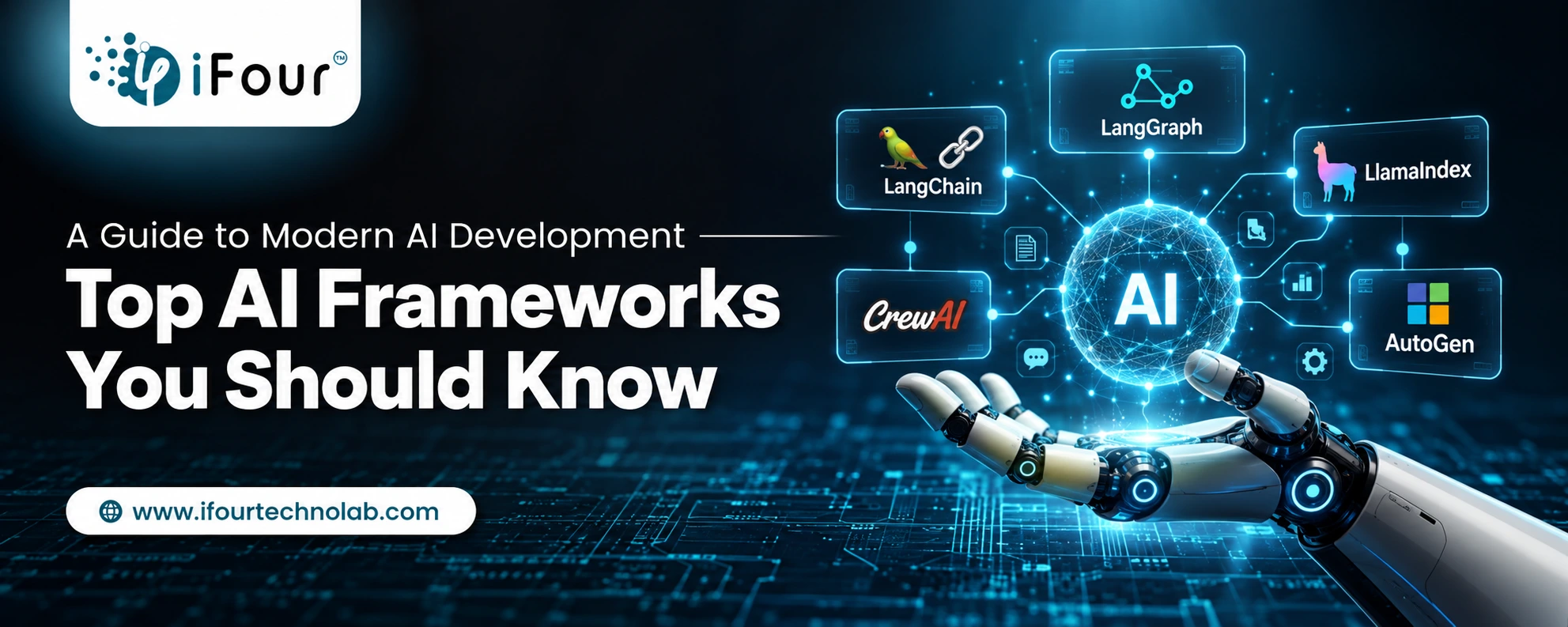
Top AI Frameworks Recommended on Reddit For Enterprise Use

19 October 2026

Kapil Panchal

Top AI Frameworks Recommended on Reddit For Enterprise Use

Quick Summary: Choosing the right AI framework depends on your goals. TensorFlow and PyTorch are ideal for deep learning, while LangChain, LlamaIndex, AutoGen,...


Why AI Agents Fail Without Context (And How Fabric Ontology Fixes It)

05 October 2026

Kapil Panchal

Why AI Agents Fail Without Context (And How Fabric Ontology Fixes It)

Quick Summary: AI agents don't fail because they lack intelligence. They fail because they lack business context. Enterprise data often contains information but not meaning. Fabric...
Building AI Agents: A Strategic Guide for CTOs

31 March 2026

Kapil Panchal

Building AI Agents: A Strategic Guide for CTOs

AI agents are everywhere these days. The world's biggest tech players - Microsoft, Alphabet, Amazon, and Meta are investing heavily in AI infrastructure, with spending expected...