







































The Economic Impacts of Microsoft Foundry: Forrester Study
Let's be honest... almost every business is adopting AI. They're building copilots, automating business processes, accelerating decision-making, and looking for new ways to create...

601 & 612, The Times square Arcade, Near Baghban party plot, Thaltej - Shilaj Road, Thaltej, Ahmedabad, Gujarat - 380059
Reviewed by:
Ajay Patel
Listening is fun too.
Straighten your back and cherish with coffee -PLAY !
Quick Summary:
Choose PyTorch if your goal is to build rapid prototypes, experiment with new models, and market them quickly.
Choose TensorFlow if your goal is to build neural networks with custom features, deploy AI across enterprise systems, mobile apps, and production environments with greater operational control and scalability.
I recently came across a discussion where someone asked, “If you're building an AI solution today, should you choose PyTorch or TensorFlow?”
And honestly, it's a fair question.
In our previous blog, we explored the AI frameworks CEOs commonly prefer when investing in AI development services.
But when it comes to actually building deep learning solutions, the conversation often narrows down to two names:
PyTorch and TensorFlow.
At first, they might look quite similar.
So if both can get the job done, does the framework you choose even matter?
Well, it does.
Because the way of developing AI models, optimizing their performance, scaling AI workloads, and moving solutions into production looks very different (depending on the framework you choose).
Connect Agents Without Limits
Accelerate AI adoption with MCP server consulting and development
And for business leaders, that difference would align directly with:
So let's break down PyTorch and TensorFlow, understand where each one shines, and see which framework brings greater value for businesses.
TensorFlow and PyTorch are the most widely used AI frameworks in enterprises for deep learning initiatives. Given below are the basic differences that are worth knowing:
| Aspect | PyTorch | TensorFlow |
|---|---|---|
| Who | Developed by Meta AI and now maintained by the Linux Foundation | Developed and backed by Google |
| How It Feels to | Works much like regular Python, making development more natural | Offers eager execution but is optimized for production-scale workflows |
| Ease of Learning | Easier for beginners and researchers to understand and debug | Takes a bit longer to learn, though Keras simplifies development |
| Best Use Cases | AI research, LLMs, experimentation, and custom model development | Enterprise AI, large-scale production, mobile apps, and web deployment |
| Flex | Highly flexible and ideal for rapid prototyping | More structured and geared toward production environments |
| Debugging Experience | Simple debugging using standard Python tools | Debugging is improving but can be more complex |
| Deployment Options | TorchServe, ExecuTorch, and ONNX export | TensorFlow Serving, TensorFlow Lite, and TensorFlow.js |
| Mobile & Edge AI | Growing support through ExecuTorch | Strong ecosystem with TensorFlow Lite |
| Cloud Integration | Works across cloud platforms | Especially strong with Google Cloud and TPUs |
| Popular Among | Researchers, AI engineers, and LLM developers | Enterprises, production teams, and Google Cloud users |
While these are the basic differences between TensorFlow and PyTorch, business leaders usually think from a business point of view. For example:
| Factor | PyTorch | TensorFlow |
|---|---|---|
| Ease of Development | Faster and more flexible for building AI prototypes | More structured for enterprise-scale development |
| Time to Market | Often preferred for rapid experimentation and iteration | Strong for long-term, production-focused projects |
| Production Readiness | Suitable for deployment with growing enterprise adoption | Widely recognized for large-scale production environments |
| Scalability | Scales well for many AI applications | Designed for large-scale enterprise AI deployments |
| Enterprise Adoption | Popular among startups and innovation-focused teams | Commonly used in enterprise and corporate environments |
| Talent | Strong adoption among AI researchers and developers | Large global developer and enterprise talent pool |
| Mobile & Edge AI | Supports mobile deployments | Mature ecosystem for mobile and edge AI solutions |
| Best Fit | R&D initiatives, Rapid innovation, custom AI products | Enterprise AI platforms, production systems, large-scale deployments |
Let us delve deeper into each and understand which AI framework creates more business value.
Honestly, CEOs or CTOs don't lose sleep over model architectures or framework syntax.
"How quickly can we get this AI product into customers' hands?"
Because every month spent in development is a month competitors can spend winning market share.
This is where PyTorch often gets an edge.
So, to answer: Which framework speeds up AI development? – It's PyTorch.
The reason is its intuitive, Python-friendly approach, which makes AI developers experiment with prototypes, modify models, and test ideas quickly with less complexity.
TensorFlow, while extremely powerful, typically comes with a steeper learning curve and a more structured development approach.
That structure best suits large-scale production environments; however, it can sometimes slow down early-stage experimentation.
So if your primary goal is to move from idea to working prototype as quickly as possible, PyTorch is often the preferred choice.
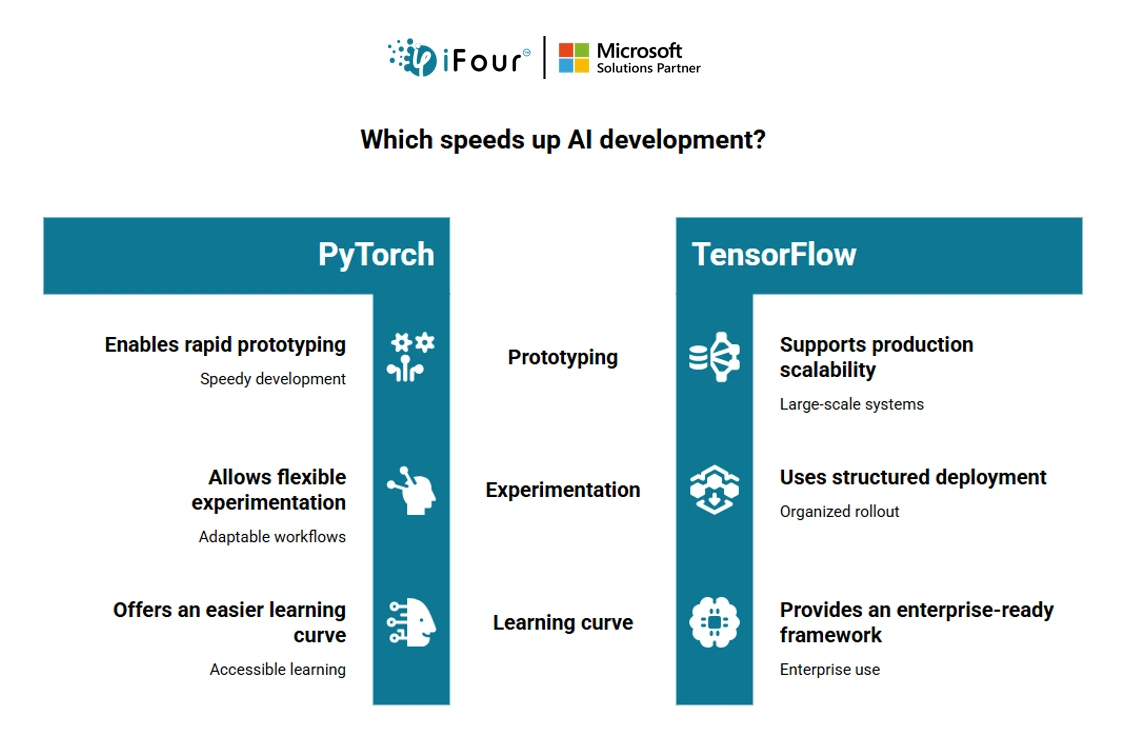
Image: PyTorch vs TensorFlow - Performance
Again, it's PyTorch. It simplifies debugging and model iteration, enabling developers to identify and resolve issues faster.
That means less time spent troubleshooting and more time spent improving the product.
For CEOs focused on speed-to-market, the takeaway is straightforward.
Apart from speed and efficiency, executives often think about AI tool is "How does this affect my investment?"
Because every week spent on AI development increases costs while delaying returns.
Industry observers note that while both frameworks remain capable, PyTorch is often viewed as the frontrunner for rapid AI innovation and model fine-tuning.
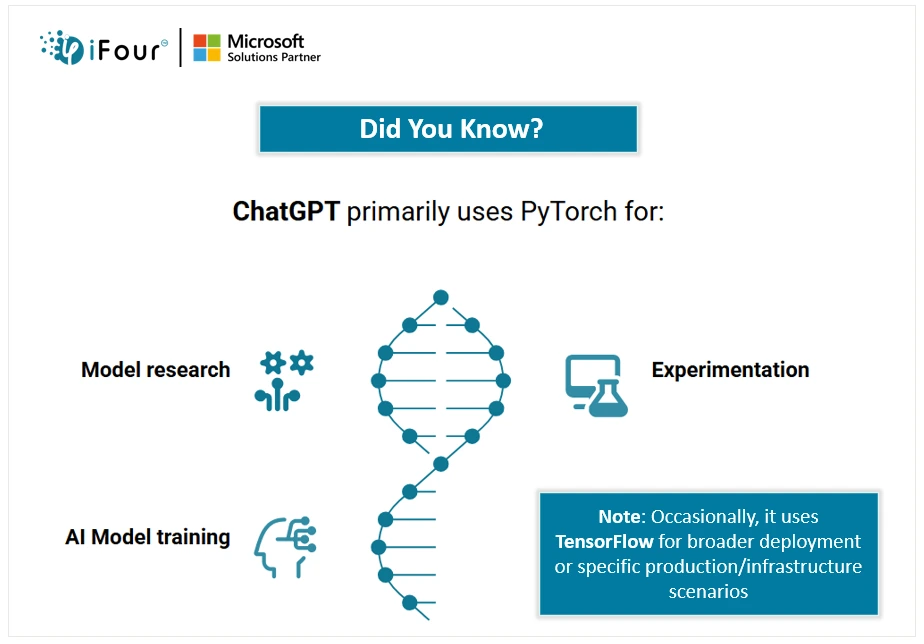
Image: Which model is used in ChatGPT?
If your focus is on mature, highly scaled production environments where long-term operational structure matters, TensorFlow may justify the additional upfront investment.
Just ask a room full of AI developers which framework they'd recommend today, and you'll probably hear PyTorch mentioned quite a bit.
The reasons are usually the same: quicker experimentation, easier debugging, and a smoother development experience.
PyTorch is a dominant machine learning framework with a stronger adoption rate among AI researchers, machine learning practitioners, and the open-source AI community.
Many cutting-edge AI models and research projects are released in PyTorch first.
You would even wonder to know that, more than 90% of the models on Hugging Face rely on PyTorch? This adoption rate has made PyTorch the default choice for firms that fine-tune gen AI and LLMs (Large Language Models).
A larger community means more tutorials, community support, reusable code, and faster problem-solving.
Which is easier to hire for?
Which has lower dependency on niche talent?
Give Data Business Meaning
Build connected intelligence with Fabric Ontology consulting services
CEO Takeaway
Bottom Line
Across developer forums, a common theme is emerging: organizations prioritizing rapid innovation and LLM development are increasingly leaning toward PyTorch as their framework of choice.
Is it backed by a major ecosystem?
Will it remain relevant?
CEO Takeaway
Bottom Line
Beyond the hype, another aspect CTOs often think about is the integration of deep learning models into their current technology stack.
Its mature ecosystem includes tools such as TensorFlow Serving, TensorFlow Lite, and TensorFlow Extended (TFX), which are designed for production deployment and management.
Build Agents That Deliver
Automate complex tasks with Copilot Agent development services
Platforms like Reddit often highlight PyTorch as the preferred framework when it comes to rapid AI innovation & experimentation.
It has a flexible architecture, and several breakthrough AI models and research projects are developed in PyTorch before reaching other frameworks.
So, in a nutshell, Community conversations and industry discussions indicate a growing preference for PyTorch for modern AI, deep learning, and large language models.
On the Flipside, TensorFlow is good for large-scale AI deployments.
If your goal is to stay ahead of competitors, you should go with PyTorch, since its flexibility, speed, and strong AI ecosystem provide a greater strategic advantage.
Build the right AI foundation from day one. Partner with iFour for strategic AI consulting services.
To summarise, PyTorch is leading the way in several aspects when compared to TensorFlow.
PyTorch is often chosen when speed, experimentation, and innovation are priorities, while TensorFlow is commonly preferred for large-scale, enterprise-focused AI deployments.
Balancing AI innovation with your production needs; choose the best one.
Not necessarily. TensorFlow has long been strong in production, but PyTorch has caught up significantly. Today, both can handle production workloads well.
Both of these deep learning frameworks scale effectively. TensorFlow has a strong enterprise track record, while PyTorch now supports large-scale AI applications and LLMs with ease.
PyTorch is often more cost-effective for experimentation because teams can build and iterate faster, reducing development time.
It depends on their goals. Companies focused on rapid AI innovation often choose PyTorch, while those with existing TensorFlow ecosystems may continue using TensorFlow.
Look at development speed, talent availability, scalability, deployment needs, ecosystem support, and long-term ROI.
For most AI and generative AI projects, PyTorch typically helps teams move from concept to prototype and deployment faster.
Choose PyTorch if you're building cutting-edge AI solutions and want access to the latest innovations first.
It's also a great fit when your team needs flexibility to experiment, debug quickly, and customize AI models without restrictions.
Choose TensorFlow if your goal is to deploy AI across mobile apps, web applications, or edge devices. It's also a strong choice when you're building AI at enterprise scale and need a framework that's optimized for production environments and integrates well with Google Cloud.

A passionate Technical writer and an SEO freak working as a Content Development Manager at iFour Technolab, USA. With extensive experience in IT, Services, and Product sectors, I relish writing about Azure Cloud, Data Analytics, AI, & Workflow Automation and love sharing exceptional insights on various platforms. I believe in constant learning and am passionate about being better every day.


Build Your Agile Team
Recent Posts
PyTorch vs TensorFlow: Choosing The Right AI Framework (For Enterprises)
November 26, 2026
The Economic Impacts of Microsoft Foundry: Forrester Study
November 16, 2026
Top AI Frameworks Recommended on Reddit For Enterprise Use
October 19, 2026

AI in Legal Practice: Powerful Use Cases Every Lawyer Should Know
September 10, 2026
Categories
Let's be honest... almost every business is adopting AI. They're building copilots, automating business processes, accelerating decision-making, and looking for new ways to create...
Quick Summary: Choosing the right AI framework depends on your goals. TensorFlow and PyTorch are ideal for deep learning, while LangChain, LlamaIndex, AutoGen,...
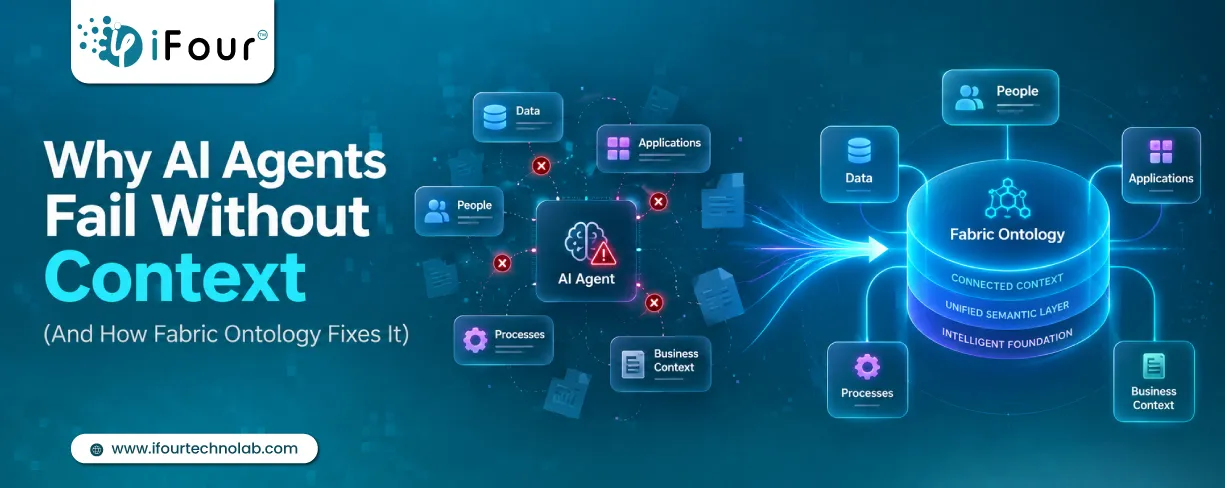
Quick Summary: AI agents don't fail because they lack intelligence. They fail because they lack business context. Enterprise data often contains information but not meaning. Fabric...

Get this Demo!
Get this Demo!
Get this Demo!
Get this Demo!
Get this Demo!
Get this Demo!