Let’s keep it simple. In healthcare, trust, safety, and human dignity come first, no matter what solution you build.
The same applies to AI. Today, it is everywhere, from clinics to corporations, but its presence doesn’t guarantee safety. The reason? It’s just a machine that does not make ethical choices nor have moral understanding.
Embedding ethical AI in healthcare software needs to be done carefully since every decision here can impact patient safety.
In this blog, we will be discussing “what are the ethical considerations of using AI in healthcare software? and why it is important in healthcare.”
Why Ethical AI Matters?
Ethical AI or responsible AI in healthcare directly influences HIPAA compliance, patient outcomes, and sustainable adoption. It should not compromise patient safety, prognosis, and data protection regulations (GDPR and HIPAA compliance).
See it as a core design rule woven through every phase, from design to deployment.
Webinar
AI in Healthcare: HIPAA Compliance & Privacy Risks You Must Understand
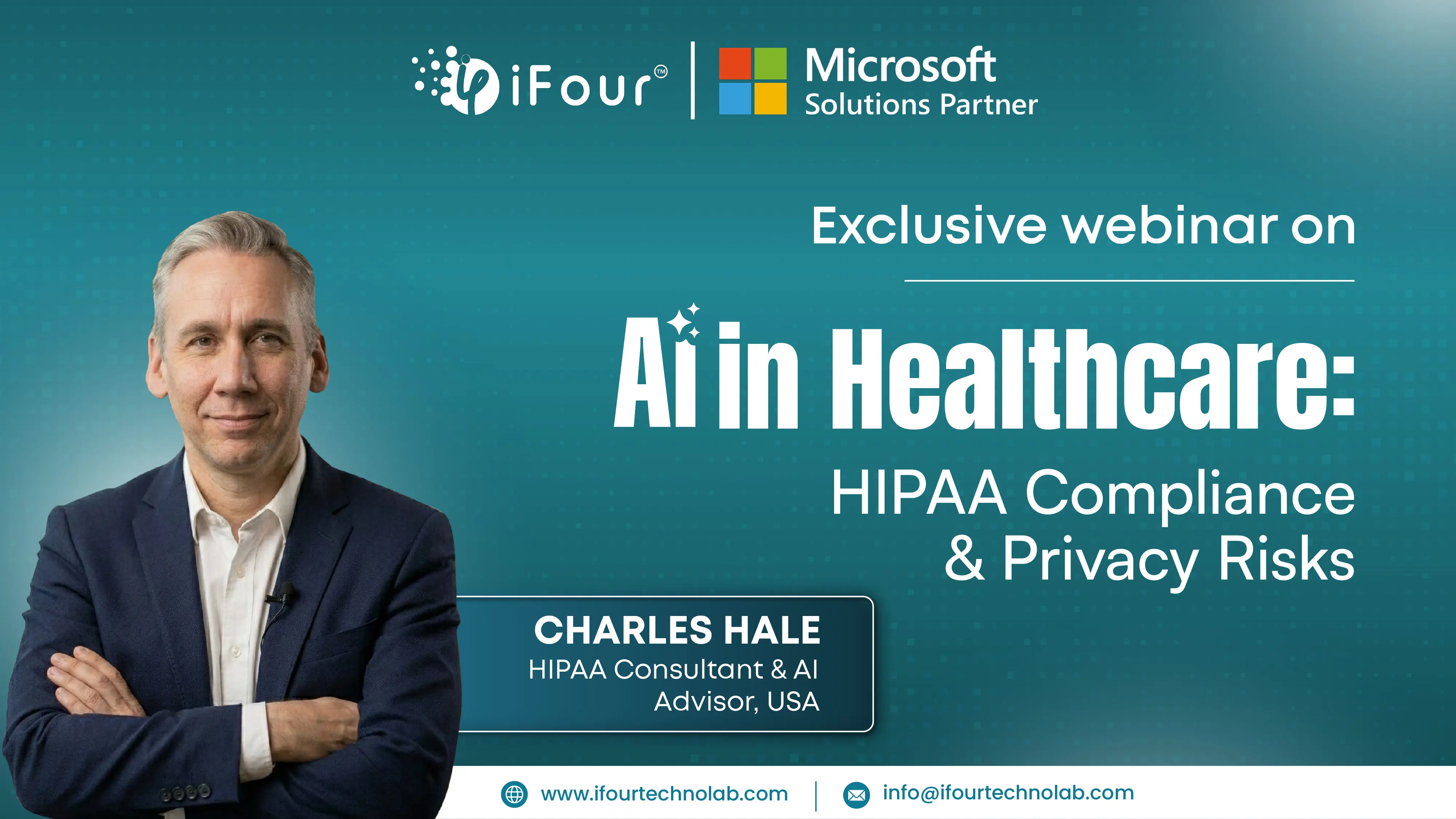
Recently, iFour hosted a webinar on how healthcare organizations can adopt AI responsibly while protecting patient privacy and meeting HIPAA compliance obligations.
The webinar was led by Charles Hale, HIPAA Consultant & AI Advisor, USA
Key Aspects Covered:
How HIPAA regulations apply to AI in healthcare
Common workflow and privacy risks with AI adoption
Guardrails to prevent PHI exposure and compliance gaps
Practical steps to integrate AI securely into healthcare workflows
Real-world examples of responsible AI use in imaging and clinical operations
Watch Webinar
22 min
22-minute expert discussion
AI in Healthcare: HIPAA Compliance & Privacy Risks You Must Understand
See, how you can turn your complex medical data into instant insights & summaries using LLM development services
Top Ethical Issues in Healthcare (Key Considerations For AI)
Ethical AI works best when humans lead the judgment calls. It keeps patients safer and helps deliver innovative yet responsible care.
Given below are some of the top ethical considerations when deploying AI in clinical software.
(1) Patient Safety and Non-Maleficence
Patient data is highly sensitive, so protecting privacy and ensuring compliance is critical.
AI recommendations must never compromise patient safety. This requires rigorous clinical validation, extensive testing, and clearly defined human oversight. AI should support—not replace - clinical judgment.
Imagine this scenario…
Let’s say you have an AI model that recommends treatment plans based on historical patient data.
What could go wrong?
The model suggests an inappropriate treatment due to insufficient clinical validation.
Why does it matter?
Patient harm, delayed recovery, or medical liability.
Look at the following video showing “What are the risks of using AI in healthcare?”
(2) Data Privacy and Regulatory Compliance
Healthcare AI systems deal with confidential patient data, strong encryption, strict access control, and anonymization.
Therefore, following HIPAA/GDPR rules is essential to protect privacy and enhance trust.
Let’s understand with an example.
Let’s say you have an AI-powered diagnostic tool processing patient records in real time.
Here’s the Risk you’ll see:
- Sensitive health data is exposed or mishandled.
The Impact it can have:
- Breach of patient trust, regulatory penalties under HIPAA or GDPR.
Ethical Principle to keep in mind:
- Respect for privacy and confidentiality.
Here’s how to implement responsibly:
- Encrypt data, apply strict access controls, anonymize data where possible, and align data handling practices with healthcare regulations.
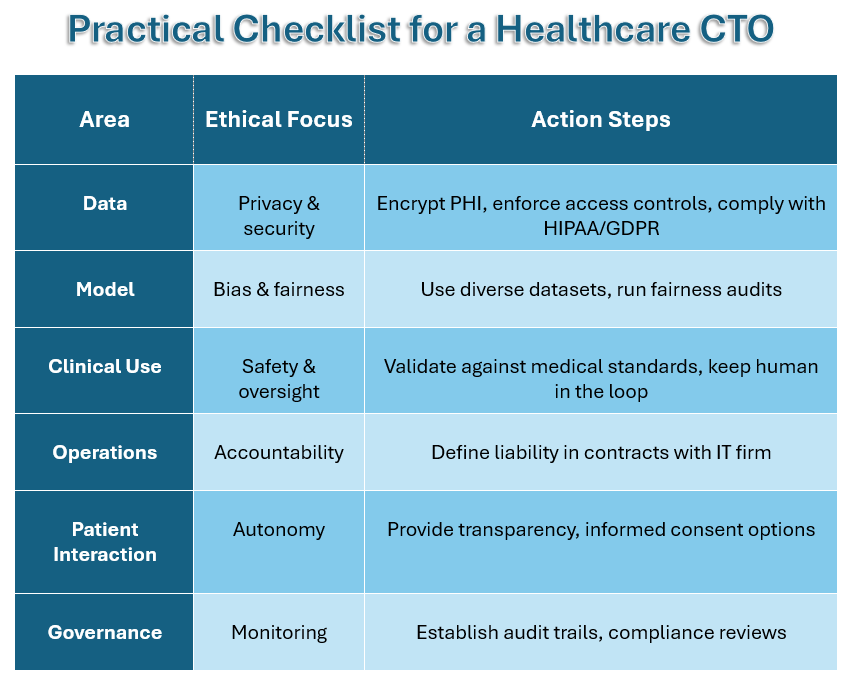
Take a look at the following image displaying the ethics of using artificial intelligence in the medical field, helping CTOs overcome ethical challenges in medical AI.
They have direct implications for patient safety, clinical trust, regulatory compliance, and the long-term viability of AI-powered healthcare systems. c
(4) Transparency and Explainability
Clinicians and patients should be able to understand how AI systems arrive at decisions.
Explainable AI improves adoption, supports clinical validation, and prevents over-reliance on opaque “black-box” models that erode trust.
Imagine this scenario:
Let’s say you have a clinical decision-support AI that provides recommendations without explanations.
What could go wrong?
- Clinicians cannot understand or validate AI outputs.
Why does it matter?
- Reduced trust, poor adoption, and unsafe reliance on AI.
- Use explainable AI techniques, document decision logic, and provide clear reasoning alongside AI recommendations.
This way, you implement AI ethics in your healthcare solution.
(5) Accountability and Liability
Clear accountability must be defined when AI contributes to adverse outcomes.
Responsibilities should be established across stakeholders—healthcare leadership, clinicians, IT partners, and AI vendors - to avoid ambiguity and legal disputes.
Unclear accountability resulting in legal disputes between CTOs, IT partners, and clinicians
To get rid of healthcare AI ethical challenges, following best practices is essential.
Human oversight keeps medical judgment at the center, with AI serving as a supportive tool rather than a replacement. Ultimately, ethical AI safeguards patient outcomes, strengthens accountability, and helps healthcare providers deliver care that is both innovative and responsible.
This will help in making AI healthcare software compliant and ethical. That’s it from this article. Hope you found this interesting and informative.
Want to build cloud-based ethical AI healthcare software? Partner with iFour. We’re a trusted healthtech company with proven solutions and over 300 happy clients.
Ethical considerations in medical AI – Summary
It is doubtless to say that AI is transforming the world, but that doesn’t mean you can deploy it and walk away.
In healthcare, privacy, fairness, and responsibility must be closely monitored. If not, the consequences can be life-threatening.
Talking about AI healthcare software development, CTOs must consider ethical AI as a foundational design principle.
Accountability, transparency, privacy, and governance embedded in healthcare AI software - protect patient data and trust.
In this blog, we discussed the following ethics of explainable AI (XAI) in healthcare:
Beneficence: AI should improve patient well-being and outcomes.
Non-maleficence: AI must avoid errors that could harm patients.
Autonomy: Patients should have informed consent and know how AI affects decisions.
Justice: AI must ensure fair, equal care for all groups.
This way, you deal with the risks of unethical AI in healthcare systems.
Ethical AI in Healthcare: Key Considerations For Patient Safety
Let’s keep it simple. In healthcare, trust, safety, and human dignity come first, no matter what solution you build.
The same applies to AI. Today, it is everywhere, from clinics to corporations, but its presence doesn’t guarantee safety. The reason? It’s just a machine that does not make ethical choices nor have moral understanding.
Embedding ethical AI in healthcare software needs to be done carefully since every decision here can impact patient safety.
In this blog, we will be discussing “what are the ethical considerations of using AI in healthcare software? and why it is important in healthcare.”
Why Ethical AI Matters?
Ethical AI or responsible AI in healthcare directly influences HIPAA compliance, patient outcomes, and sustainable adoption. It should not compromise patient safety, prognosis, and data protection regulations (GDPR and HIPAA compliance).
A single negligence could result in fatal issues.
Therefore, CTOs should build AI-based healthcare software with ethical considerations.
See it as a core design rule woven through every phase, from design to deployment.
Webinar
AI in Healthcare: HIPAA Compliance & Privacy Risks You Must Understand
Recently, iFour hosted a webinar on how healthcare organizations can adopt AI responsibly while protecting patient privacy and meeting HIPAA compliance obligations.
The webinar was led by Charles Hale, HIPAA Consultant & AI Advisor, USA
Key Aspects Covered:
How HIPAA regulations apply to AI in healthcare
Common workflow and privacy risks with AI adoption
Guardrails to prevent PHI exposure and compliance gaps
Practical steps to integrate AI securely into healthcare workflows
Real-world examples of responsible AI use in imaging and clinical operations
Watch Webinar
22 min
22-minute expert discussion
AI in Healthcare: HIPAA Compliance & Privacy Risks You Must Understand
22-minute expert discussion · iFour Technolab
See, how you can turn your complex medical data into instant insights & summaries using LLM development services
Top Ethical Issues in Healthcare (Key Considerations For AI)
Ethical AI works best when humans lead the judgment calls. It keeps patients safer and helps deliver innovative yet responsible care.
Given below are some of the top ethical considerations when deploying AI in clinical software.
(1) Patient Safety and Non-Maleficence
Patient data is highly sensitive, so protecting privacy and ensuring compliance is critical.
AI recommendations must never compromise patient safety. This requires rigorous clinical validation, extensive testing, and clearly defined human oversight. AI should support—not replace - clinical judgment.
Imagine this scenario…
Let’s say you have an AI model that recommends treatment plans based on historical patient data.
What could go wrong?
The model suggests an inappropriate treatment due to insufficient clinical validation.
Why does it matter?
Patient harm, delayed recovery, or medical liability.
What ethical principle applies here?
Non-maleficence - AI must not cause harm.
So how do we handle this responsibly?
Validate healthcare AI models through clinical trials, conduct rigorous testing, and ensure clinicians always retain final decision-making authority.
Transparent and explainable AI builds confidence among doctors and patients, while reducing bias ensures fair treatment across diverse populations.
"HIPAA Compliance isn't a Feature - it's a foundation."
Charles Hale,
Advisor,
Hale Consulting Services
"Ethics can’t be an overthought when you build an AI-based healthcare software.
CTOs leading the process must ensure every stage of SDLC is built responsibly, with strict GDPR and HIPAA compliance at the core.
Because HIPAA Compliance isn’t a feature — it’s a foundation.”
- Watch video here
Read More: How Can AI Change the Future of Telemedicine?
Look at the following video showing “What are the risks of using AI in healthcare?”
(2) Data Privacy and Regulatory Compliance
Healthcare AI systems deal with confidential patient data, strong encryption, strict access control, and anonymization.
Therefore, following HIPAA/GDPR rules is essential to protect privacy and enhance trust.
Let’s understand with an example.
Let’s say you have an AI-powered diagnostic tool processing patient records in real time.
Here’s the Risk you’ll see:
- Sensitive health data is exposed or mishandled.
The Impact it can have:
- Breach of patient trust, regulatory penalties under HIPAA or GDPR.
Ethical Principle to keep in mind:
- Respect for privacy and confidentiality.
Here’s how to implement responsibly:
- Encrypt data, apply strict access controls, anonymize data where possible, and align data handling practices with healthcare regulations.
Take a look at the following image displaying the ethics of using artificial intelligence in the medical field, helping CTOs overcome ethical challenges in medical AI.
Thus, AI ethics in healthcare software is no longer optional. It’s essential.
Reduce admin burden with Copilot consulting for healthcare.
Let’s connect
(3) Bias and Fairness in AI Models
When datasets lack diversity, AI may generate biased outcomes across various demographic groups.
Ensuring diverse data and frequent bias audits is important for equitable healthcare.
Imagine this scenario…
Let’s say you have an AI system trained primarily on data from a limited demographic group.
Here’s the Risk:
The model performs poorly for underrepresented populations.
The impact it can have:
Unequal treatment outcomes and widened healthcare disparities.
Ethical Principle that applies here:
Fairness and equity in care delivery.
How to implement responsibly:
Use diverse and representative datasets, conduct bias testing, and continuously monitor outcomes across demographics.
Read More: AI and IoT: Reshaping the Healthcare Industry in 10 Ways
These considerations are not theoretical.
They have direct implications for patient safety, clinical trust, regulatory compliance, and the long-term viability of AI-powered healthcare systems. c
(4) Transparency and Explainability
Clinicians and patients should be able to understand how AI systems arrive at decisions.
Explainable AI improves adoption, supports clinical validation, and prevents over-reliance on opaque “black-box” models that erode trust.
Imagine this scenario:
Let’s say you have a clinical decision-support AI that provides recommendations without explanations.
What could go wrong?
- Clinicians cannot understand or validate AI outputs.
Why does it matter?
- Reduced trust, poor adoption, and unsafe reliance on AI.
What ethical principle applies here?
- Transparency and explainability. (Read more about it here…)
So how do we handle this responsibly?
- Use explainable AI techniques, document decision logic, and provide clear reasoning alongside AI recommendations.
This way, you implement AI ethics in your healthcare solution.
(5) Accountability and Liability
Clear accountability must be defined when AI contributes to adverse outcomes.
Responsibilities should be established across stakeholders—healthcare leadership, clinicians, IT partners, and AI vendors - to avoid ambiguity and legal disputes.
Your data holds answers. Unlock them with our Healthcare Analytics services
Let’s discuss
Imagine you have an AI system whose recommendation contributes to an adverse patient outcome.
The Risk you’d see is:
- Unclear responsibility among the CTO, IT partner, clinicians, or vendor.
The impact it can have:
- Legal disputes and operational disruption.
What Ethical Principle applies here?
- Accountability.
How to build this responsibly?
- Clearly define ownership, decision boundaries, and liability roles across all stakeholders before deployment.
Read More: 10 Business Problems You Can Solve Using Dynamics 365 AI
Safeguarding privacy, ensuring fairness, and maintaining accountability while embedding Ethical AI in healthcare is essential.
If not, the impact could literally be fatal.
(6) Informed Consent and Patient Autonomy
Patients must be informed when AI is involved in their care.
They should understand its role and retain the right to opt out, ensuring autonomy remains central to healthcare delivery.
Let’s say you have AI assisting clinicians in diagnosis or treatment planning without patient awareness.
Here’s the Risk:
- Patients are unaware of AI’s role in their care.
Here’s what could happen (Impact):
- Loss of trust and violation of patient autonomy.
Ethical Principle to apply here:
- Informed consent and respect for autonomy.
How to make AI ethically responsible?
- Disclose AI involvement, explain its purpose in simple terms, and allow patients to opt out where appropriate.
(7) Equity and Access
AI should reduce healthcare gaps, not make them worse.
Designers must consider underserved groups and accessibility from the start.
Let’s suppose you have an AI healthcare solution optimized only for urban or high-resource settings.
What’s the Risk here?
- Underserved or rural populations receive limited benefits.
The impact it can have:
- Increased healthcare inequality.
Ethical Principle that applies here:
- Equity and inclusive access.
Better care starts with better infrastructure — choose Microsoft Cloud for Healthcare
Avail it now
Here’s how to implement it responsibly:
Design AI systems with accessibility in mind and test them across diverse healthcare environments.
This way, ethical use of AI in healthcare systems can fill the healthcare gaps.
Meanwhile, look at the following carousel showcasing what to keep in mind while building Ethical AI in the medical field.
Read More: How to win more deals with AI-Powered Dynamics 365 sales
(8) Continuous Monitoring and Governance
AI systems evolve over time.
Regular audits for accuracy, bias, and compliance are essential.
Governance frameworks ensure AI remains aligned with clinical standards, ethical principles, and regulatory expectations.
Example:
Let’s say you have an AI model that performs well at launch but degrades over time.
Here’s the Risk:
- Model drift leads to inaccurate or biased recommendations.
Here’s the Impact:
- Compromised patient safety and regulatory non-compliance.
Ethical Principle that applies here is:
- Ongoing responsibility and governance.
Here’s how to implement healthcare AI responsibly:
- Establish AI governance frameworks, perform regular audits, and continuously monitor accuracy, bias, and compliance.
So, all of these are the best practices for building ethical AI driven Healthcare software.
These aren’t just abstract principles; they directly affect patient safety, trust, and regulatory compliance.
Automate clinical tasks with Agentic AI development services
Let’s connect
Risks of Ignoring Ethical Healthcare Practices
Failing to address ethical considerations can result in serious consequences:
Biased AI models leading to unequal treatment outcomes
Opaque algorithms causing loss of clinician and patient trust
Weak governance structures triggering regulatory penalties
Unclear accountability resulting in legal disputes between CTOs, IT partners, and clinicians
To get rid of healthcare AI ethical challenges, following best practices is essential.
Human oversight keeps medical judgment at the center, with AI serving as a supportive tool rather than a replacement. Ultimately, ethical AI safeguards patient outcomes, strengthens accountability, and helps healthcare providers deliver care that is both innovative and responsible.
This will help in making AI healthcare software compliant and ethical. That’s it from this article. Hope you found this interesting and informative.
Want to build cloud-based ethical AI healthcare software? Partner with iFour. We’re a trusted healthtech company with proven solutions and over 300 happy clients.
Ethical considerations in medical AI – Summary
It is doubtless to say that AI is transforming the world, but that doesn’t mean you can deploy it and walk away.
In healthcare, privacy, fairness, and responsibility must be closely monitored. If not, the consequences can be life-threatening.
Talking about AI healthcare software development, CTOs must consider ethical AI as a foundational design principle.
Accountability, transparency, privacy, and governance embedded in healthcare AI software - protect patient data and trust.
In this blog, we discussed the following ethics of explainable AI (XAI) in healthcare:
Beneficence: AI should improve patient well-being and outcomes.
Non-maleficence: AI must avoid errors that could harm patients.
Autonomy: Patients should have informed consent and know how AI affects decisions.
Justice: AI must ensure fair, equal care for all groups.
This way, you deal with the risks of unethical AI in healthcare systems.
Kapil Panchal
A passionate Technical writer and an SEO freak working as a Content Development Manager at iFour Technolab, USA. With extensive experience in IT, Services, and Product sectors, I relish writing about Azure Cloud, Data Analytics, AI, & Workflow Automation and love sharing exceptional insights on various platforms. I believe in constant learning and am passionate about being better every day.
AI agents are everywhere these days.
The world's biggest tech players - Microsoft, Alphabet, Amazon, and Meta are investing heavily in AI infrastructure, with spending expected...
Let's keep it real. The whole point of building autonomous Agents is to cut manual work and keep focus on business.
Approvals that used to take days can happen in hours because...
AI and Automation aren’t just options anymore. They are a necessity to keep yourself focused on what matters the most. Whether it is Zapier or Power Automate, ChatGPT or Copilot, every...

































































 22 min