We use cookies to improve your experience on our site. Please accept cookies for optimal performance.


601 & 612, The Times square Arcade, Near Baghban party plot, Thaltej - Shilaj Road, Thaltej, Ahmedabad, Gujarat - 380059
Ahmedabad
15 April 2026
iFour Technolab, a trusted healthcare software development company, recently hosted an essential webinar on AI governance in healthcare. The session was led by Charles Hale, founder and president of Hale Consulting Solutions and a recognized leader in healthcare regulatory compliance.
The objective of this session was to understand HIPAA compliance and privacy risks when adopting AI in healthcare.
This webinar is ideally aimed at industry practitioners who wonder:
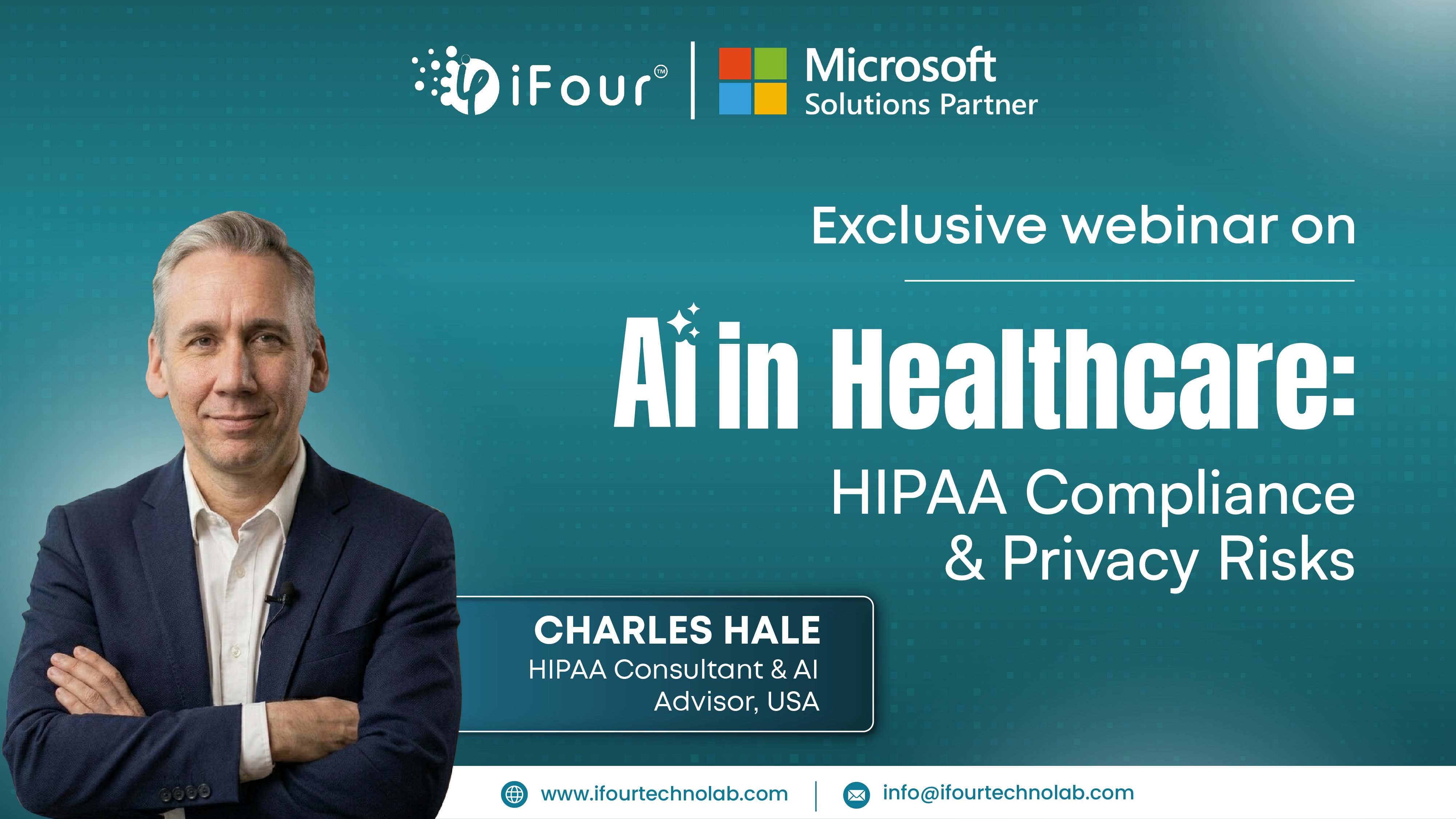
As the session began, Hemanshi, BA at iFour, welcomed everyone and set a collaborative tone by introducing the speaker, saying, “Meet Charles Hale, the founder and president of Hale Consulting Solutions and a recognized leader at healthcare IT, cybersecurity and regulatory compliance, along with AI governance.”
She invited further introductions before getting started.
Jay Shah, founder of Lericon Informatics, responded:
We work in the healthcare sector as well as life science for AI development… many of our clients always have this concern, and they are looking for a better solution. So that is what the main agenda is to attend this.
The room had found its voice. Everyone gathered wasn't just curious — they were seeking practical solutions to real problems.
iFour then introduced Charles Hale with his credentials that set the stage for what was to come.
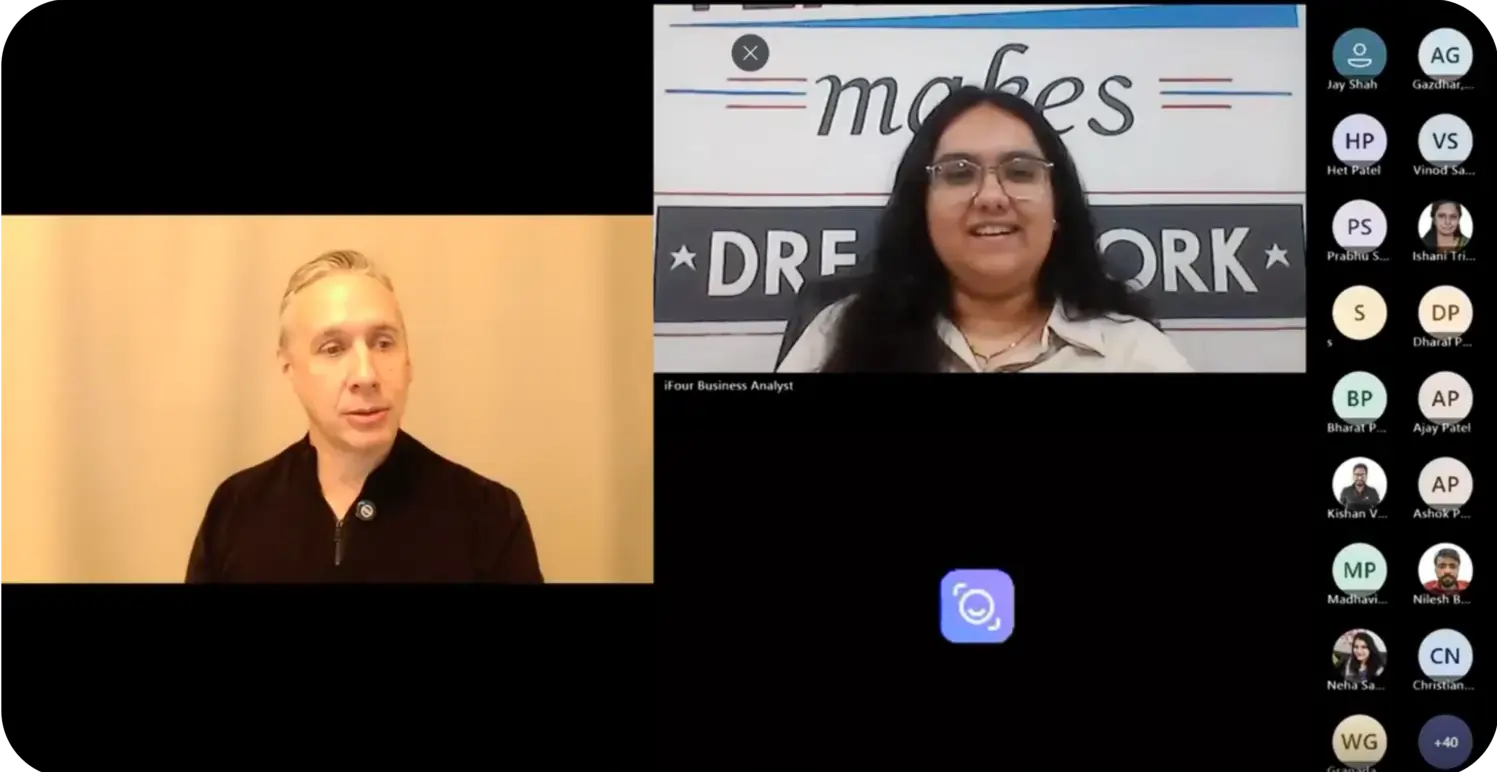
Charles didn't waste time with theory. He opened with a statement that shifted the entire conversation:
It's no longer a question of whether AI is going to be used in healthcare or when AI is being used in healthcare, it is being used in healthcare. It's not the future, it is now.
The message was clear — hospitals, clinics, and health systems aren't debating whether to adopt AI anymore. They're already using it.
Chales continued with a sobering reality:
About 80% of the systems out there, healthcare systems, don't have a formal AI governance in place.
This was the core of the webinar. Not whether AI exists in healthcare, but whether healthcare organizations have the governance to manage it responsibly.
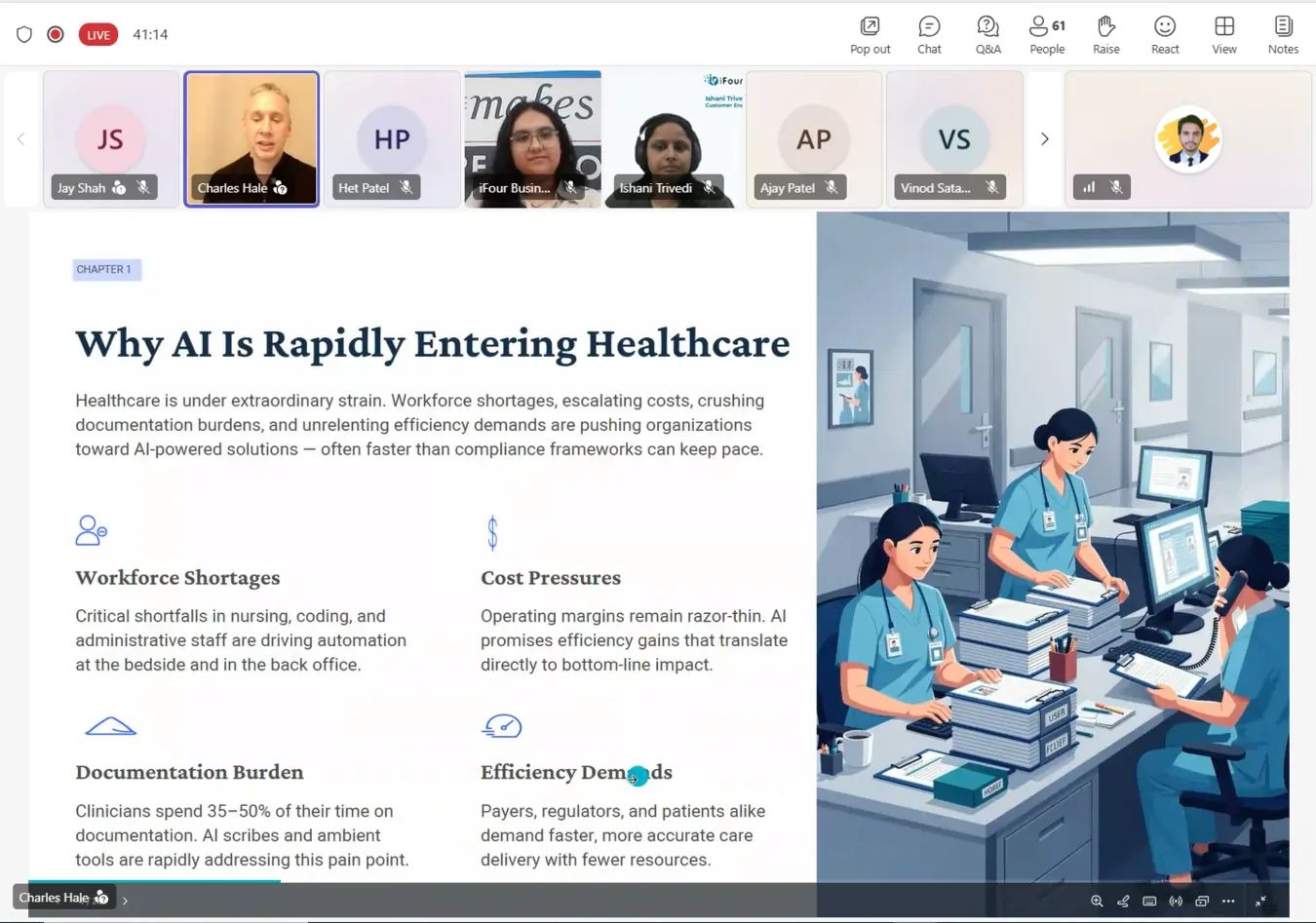
Charles then explained the drivers behind AI adoption in healthcare:
There's not enough healthcare workers and administrative staff out there to do everything that needs to be done. You can use AI to improve, to optimize and improve the productivity of your existing staff.
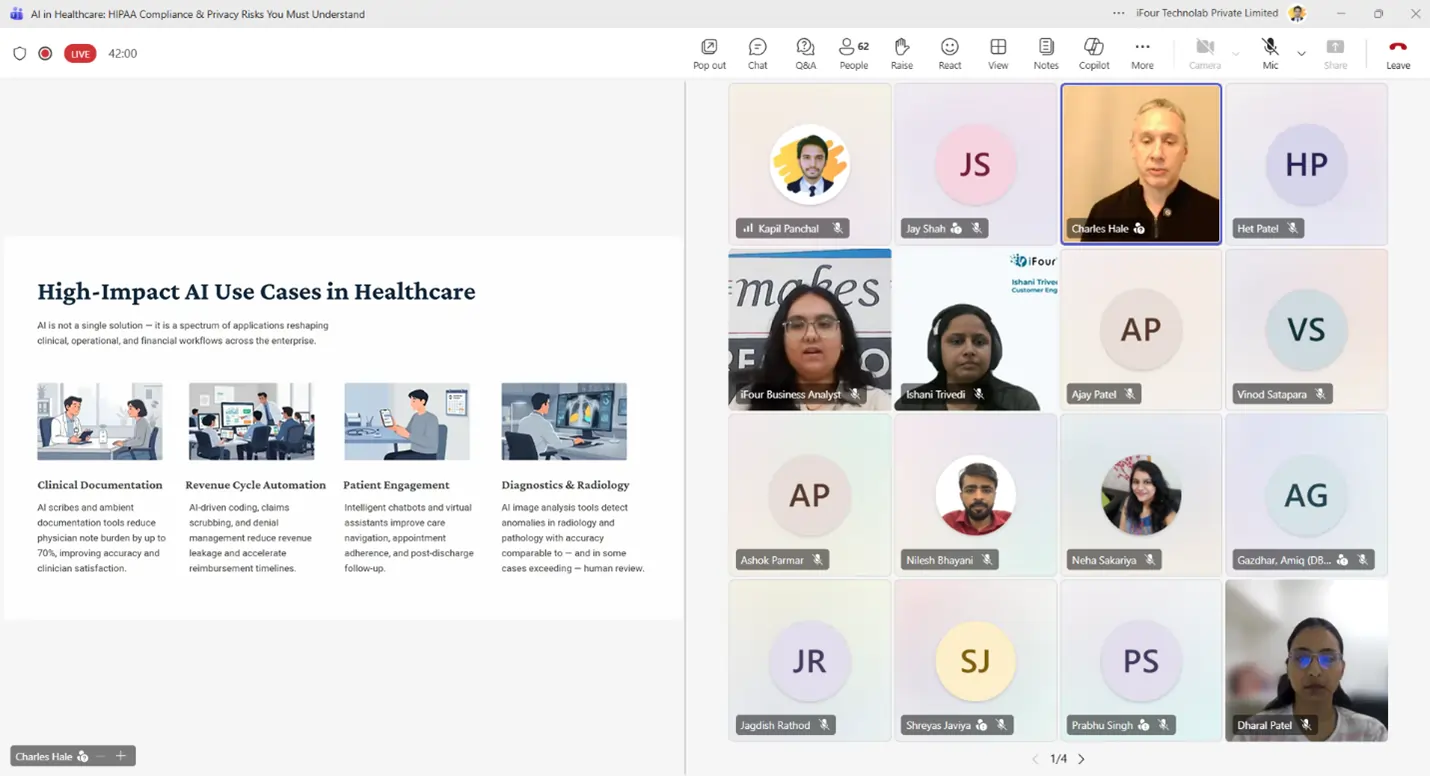
The AI use cases he highlighted were compelling:
Clinical documentation - AI transcribing patient notes automatically
Revenue cycle automation - Processing claims and billing faster
Patient engagement - Scheduling appointments, answering common questions
Diagnostics - Assisting in image analysis and disease detection
But here's where Charles became notably serious:
"With innovation definitely comes the responsibility."
This wasn't a throwaway line. It was the thesis of everything that followed.
As the conversation deepened, Charles brought up something that made the room pause.
HIPAA was written in 1996… There is nothing in HIPAA about AI. They're doing some final rule updates. We're expecting another new final rule here maybe later this year, but the current rules don't say anything about AI.
The implication sank in. Healthcare organizations are implementing AI under a compliance framework that literally predates the internet as we know it.
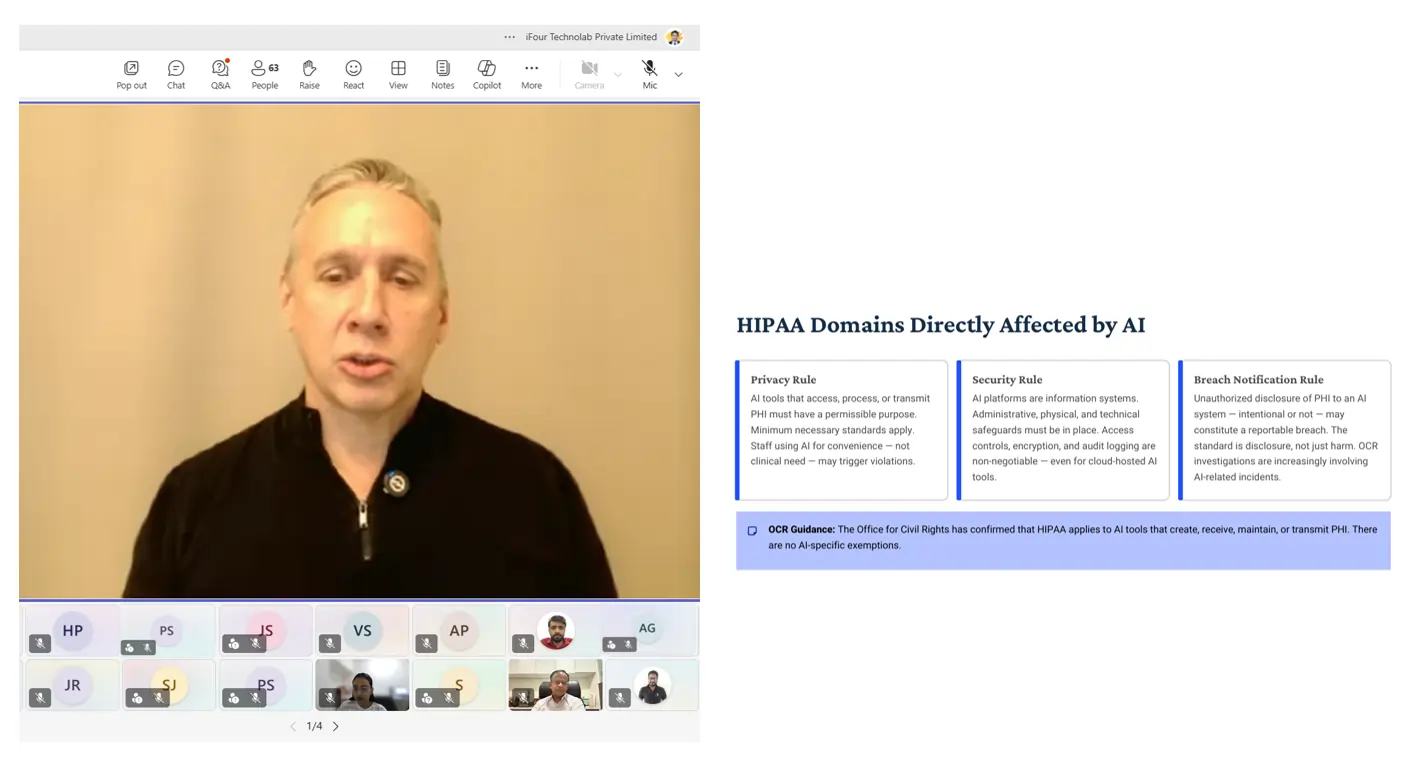
Charles then clarified something critical:
AI is just another process. It still has to comply with all of the same rules as any other technical process under HIPAA.
But how do you comply with rules that don't specifically address what you're doing?
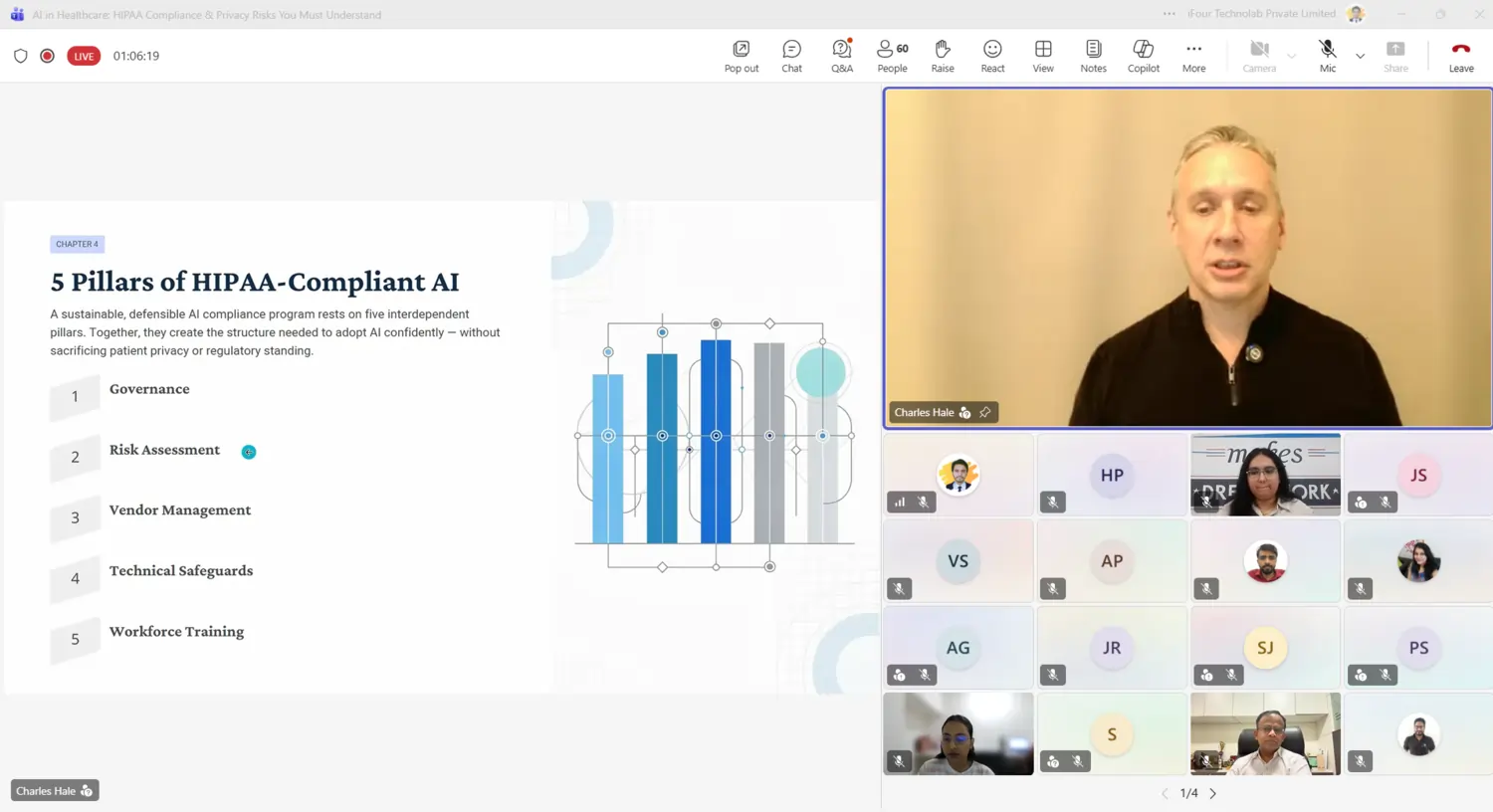
Charles then painted a scenario that every healthcare IT leader in the room understood:

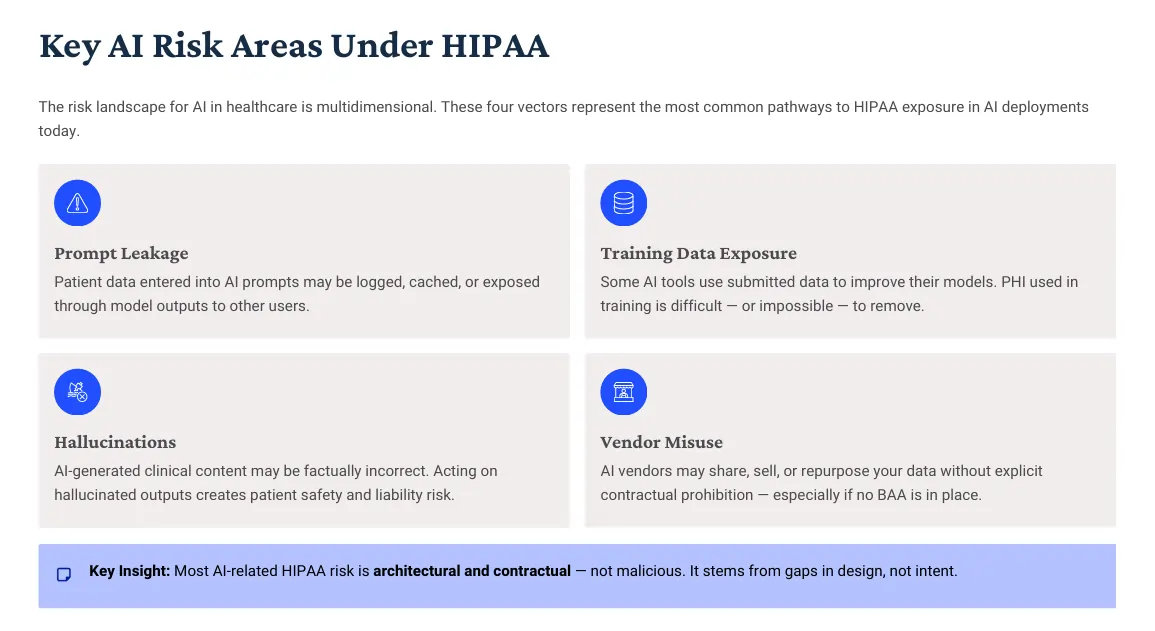
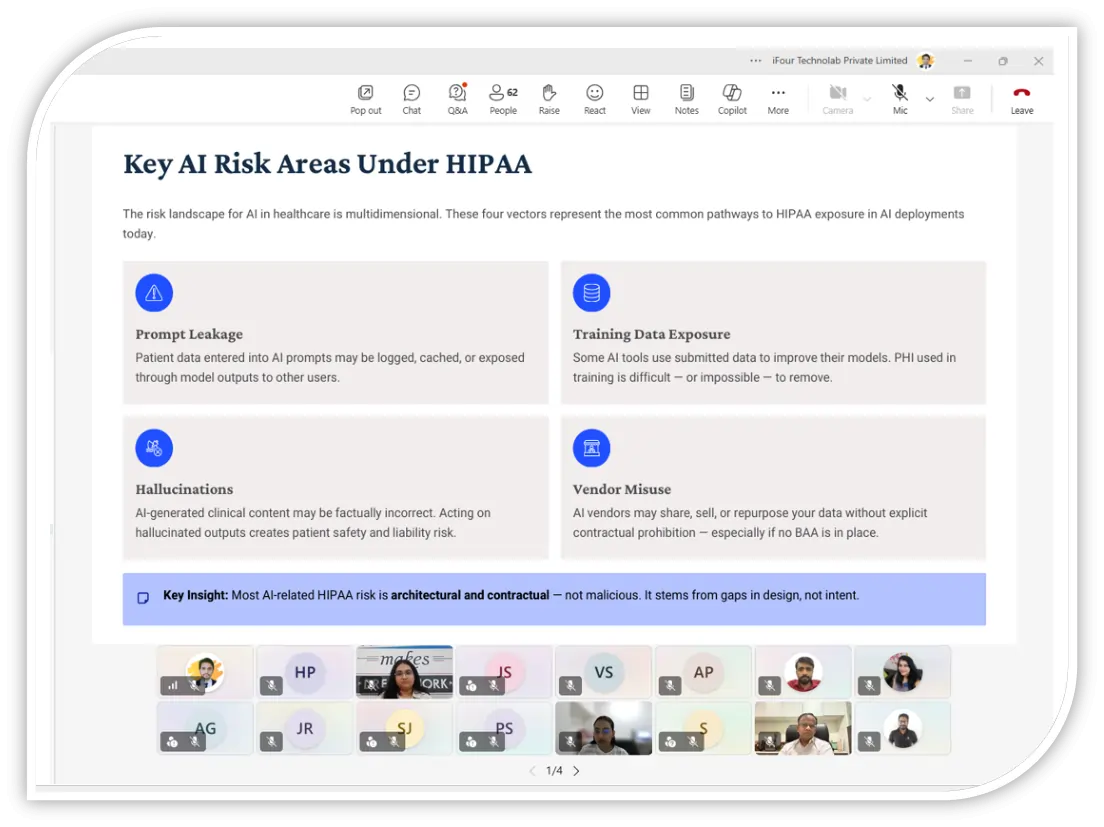
The danger wasn't from malicious actors trying to steal data. It was far more subtle.
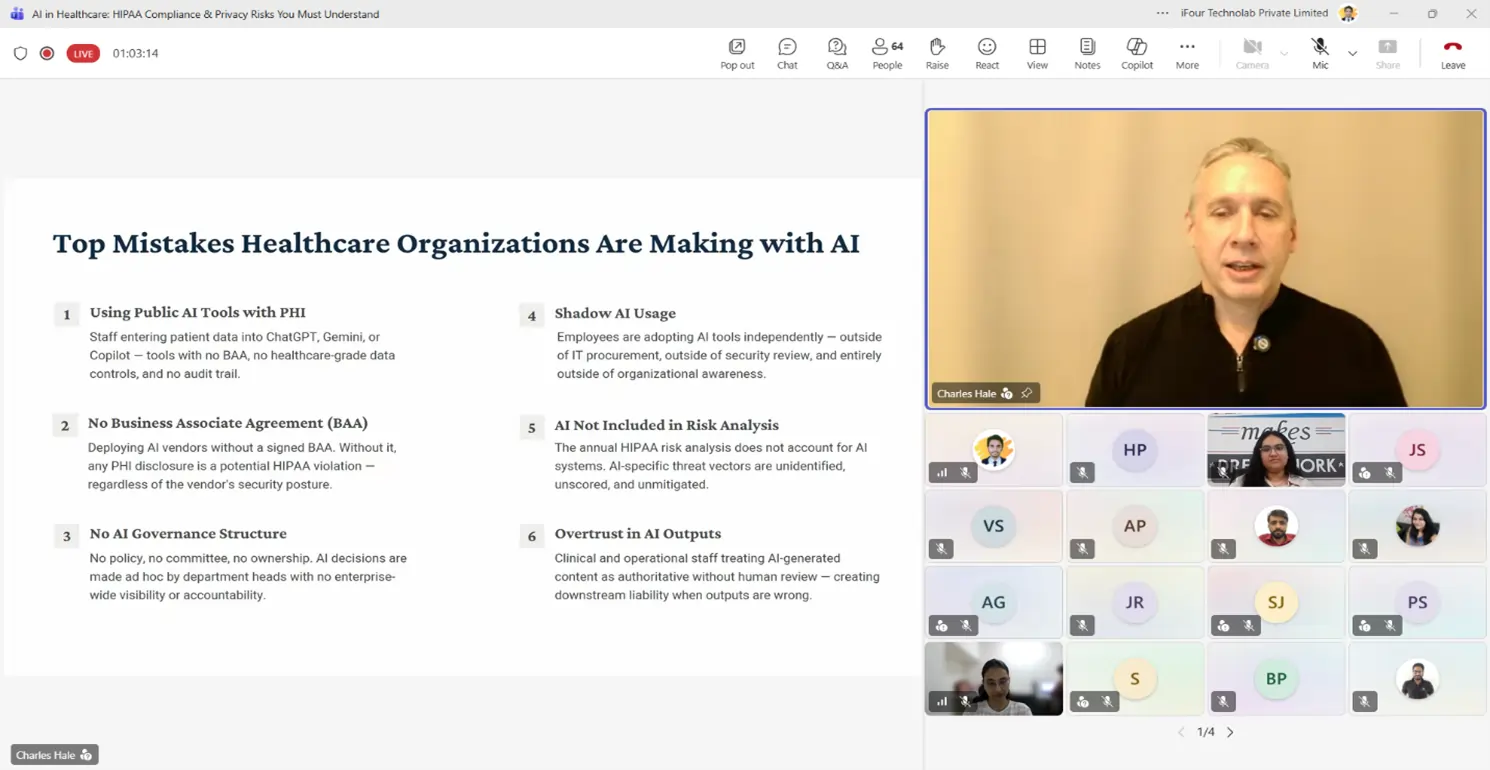
In other words, healthcare organizations weren't losing patient data because someone hacked them. They were losing it because of how they designed their systems.
A nurse copying patient information into a ChatGPT prompt to get help with documentation. A clinic using an open-source AI model without checking data isolation. A vendor claiming HIPAA compliance without explaining how data actually stays protected.
These weren't attacks. They designed oversights that created exposure.
As the session progressed, Hemanshi shared the perspective of iFour on supporting healthcare enterprises through this complexity:
iFour has been a reliable partner for healthcare clients, assisting them in navigating digital challenges in healthcare.
We have assisted them with the following key services -

What happened next was where the webinar became invaluable. Real questions from practitioners revealed the actual gaps in AI governance.
Dhawal Desai, Product Manager at iFour, asked the first question:

Charles's response was honest:
Here was a gap in the market. Organizations needed ways to gate data access for AI, but no leading standard solution existed yet.
Dr. Pooja Mehta brought up a question that revealed a different problem:
This was the accessibility problem. Large hospital systems could hire compliance officers and build sophisticated governance frameworks. But what about smaller providers?
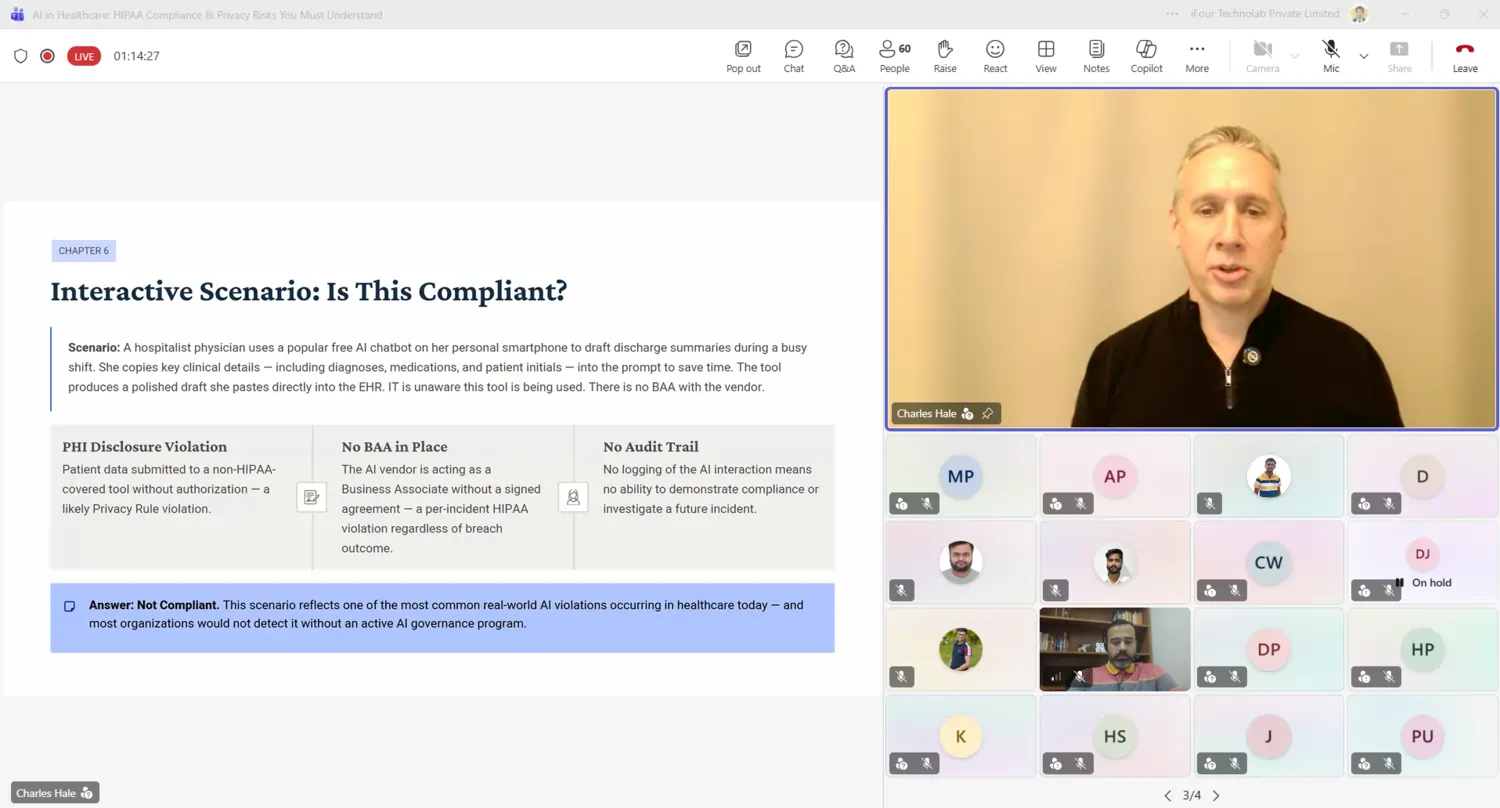
Charles's answer was refreshingly practical:
Governance wasn't about complexity. It was about intentionality.
Another participant, Hardik Deshani, questions with a scenario:
Charles broke it down:
The key insight:
If you're not sending PHI to the vendor, the vendor doesn't need HIPAA compliance. But you still need to protect the data yourself.
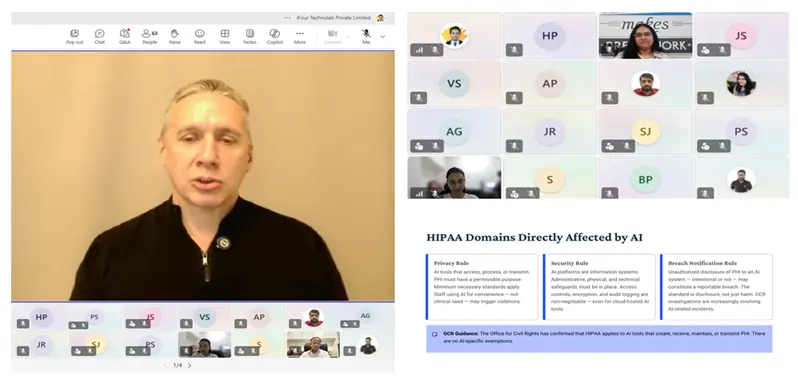
Netra Patel then asked her own question, representing what many of their clients were building:
Charles provided the architectural solution:
This was the answer many enterprises needed. Use commercial healthcare AI models, but keep data in a private, encrypted environment.
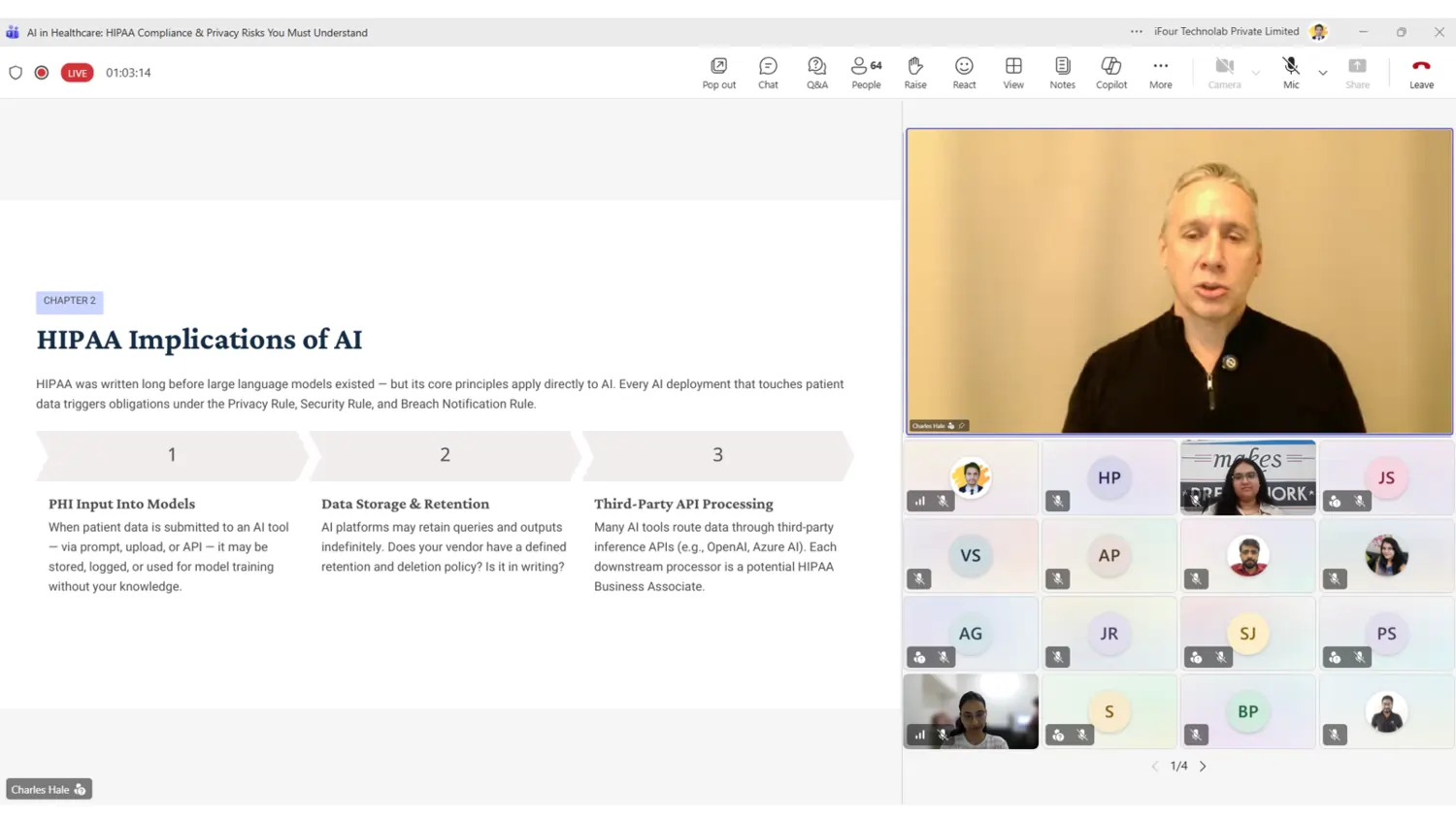
When another question came about what organizations should check first before allowing AI to handle PHI, Charles provided a practical roadmap:
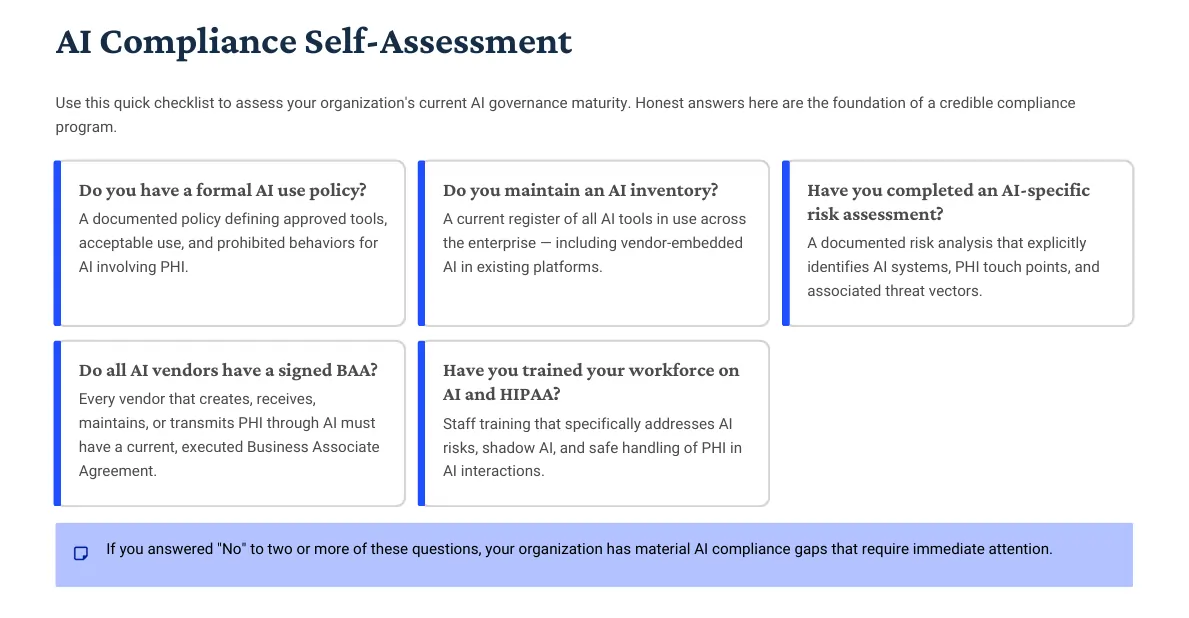
This became a checklist for the webinar attendees:
Simple. Clear. Actionable.
iFour leadership then posed a question that made everyone think:
The silence that followed was telling. Many organizations were using AI without knowing the full extent of their own AI usage.
This wasn't just a compliance issue. It was a leadership issue.
The last question from Kapil Panchal sparked curiosity about the future of healthcare regulations — a challenge many organizations actually face today.
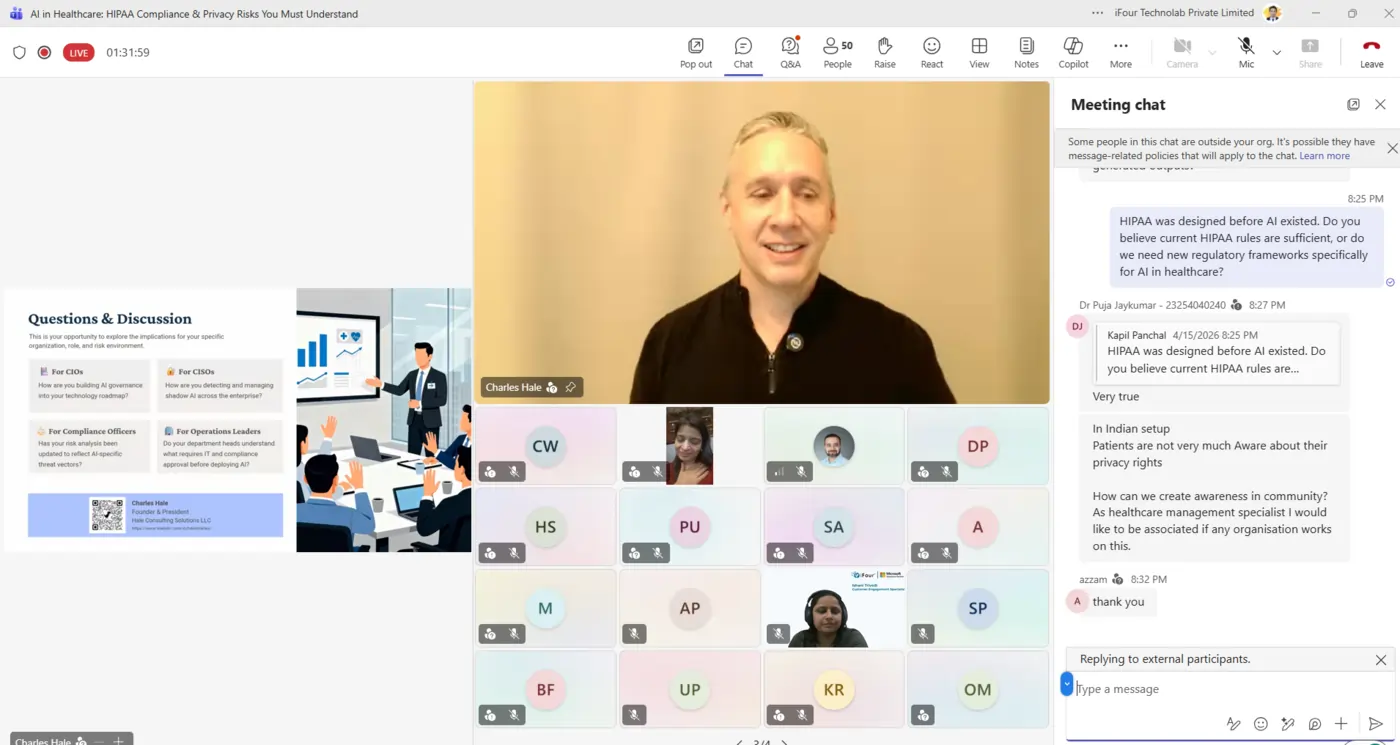
Charles responded with insight from industry leadership:
He then highlighted a broader gap that extended beyond AI:
Charles continued:
This was the bigger picture. AI in healthcare was just one piece of a regulatory framework that had fallen behind technology.
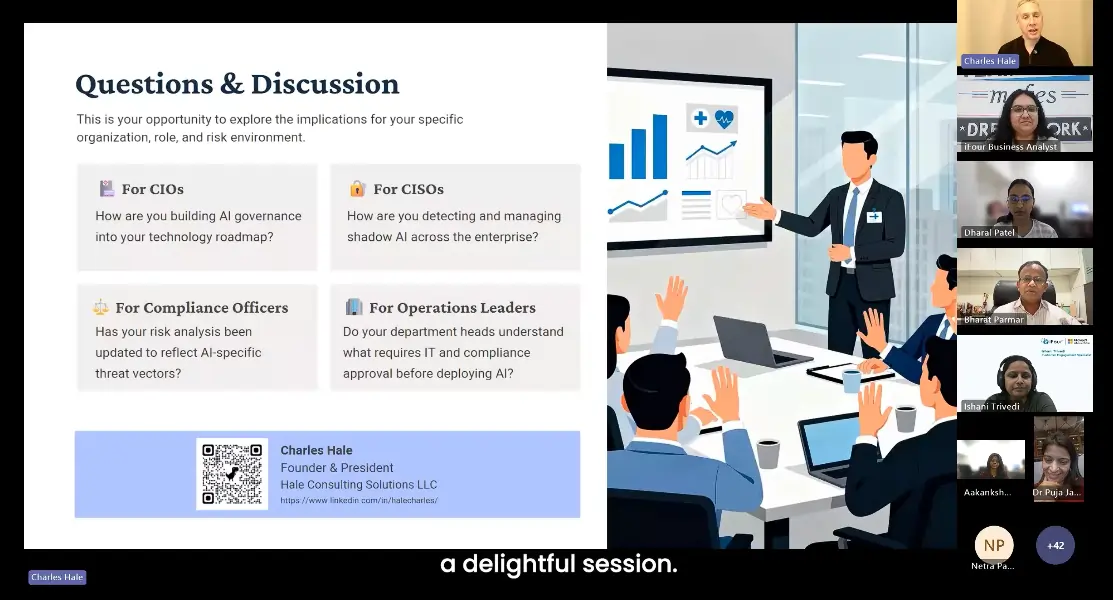
As the session concluded, iFour thanked everyone for participating:
Charles added warmly:
The webinar ended, but the conversation didn't. For healthcare organizations struggling with AI governance, this was just the beginning.
1. AI in healthcare is not a future problem — it's a present reality
80% of healthcare systems lack formal AI governance. That means the majority are using AI without adequate safeguards.
2. HIPAA compliance for AI is about architecture, not intention
Most AI-related risks aren't malicious. They stem from how systems are designed and how data flows through them.
3. Protected health information is your responsibility
If your staff inputs PHI into an AI tool, that data is now in the tool's logs and models. You must prevent this through policy and architecture.
4. Vendor claims about HIPAA compliance need scrutiny
A vendor providing a "HIPAA-compliant API" doesn't absolve you of responsibility. If you're not sending PHI to the vendor, they don't need HIPAA compliance — but you still need to protect the data yourself.
5. Data isolation and encryption are non-negotiable
Use commercial AI models, but ensure your data runs in a private, encrypted tenant where only your organization has access.
6. Small organizations don't need complex policies — they need clear ones
Healthcare governance isn't about creating 200-page binders. It's about having a clear, documented policy about how AI is used in your organization.
7. Governance requires inventory and visibility
You can't protect what you don't know you're using. Organizations need an AI inventory — a documented list of all AI-enabled systems in their infrastructure.
8. Regulatory frameworks are evolving
HIPAA will likely be updated to explicitly address AI. Until then, organizations must apply existing HIPAA principles thoughtfully to new AI use cases.
To conclude, the real challenge is Governance, not technology!
That’s all from this session on using ethical AI in healthcare. To explore more such events, click here.
Want to implement Responsible AI in your healthcare?
Talk to iFour’s healthcare software experts today and get 30 Mins Free consultation on your healthcare AI assessment.
1: What privacy risks does AI create in healthcare?
A: AI can expose sensitive patient data through misuse, bias, or insecure algorithms.
2: Do we need new regulations beyond HIPAA for AI?
A: Yes. AI introduces challenges HIPAA alone cannot address, requiring updated frameworks.
3: How does HIPAA apply to AI driven patient care?
A: HIPAA still governs patient data privacy, but AI use demands stricter safeguards and oversight.
4: What does formal AI governance in healthcare mean?
A: Formal AI governance means having documented policies about what AI tools your organization uses, how they're used, who can use them, and how patient data is protected. It includes an inventory of AI-enabled systems, clear guidelines for staff, and technical controls to prevent PHI exposure.
5: Is there a standard for AI governance in healthcare?
A: Currently, there's no single regulatory standard specifically for AI in healthcare. Organizations must apply existing HIPAA principles to AI use cases while staying informed about upcoming regulatory updates. Industry best practices include data isolation, encryption, access controls, and vendor assessment.
6: Can small clinics implement AI safely?
A: Yes. Governance doesn't require massive infrastructure. A small clinic can implement responsible AI by having a simple, documented policy about how AI is used (e.g., "We use AI for billing only, staff cannot input patient names or medical history"), ensuring data isolation and encryption, and training staff on what information can be shared with AI tools.
7: What's the difference between using a HIPAA-compliant AI tool and protecting patient data?
A: A HIPAA-compliant vendor provides contractual assurances about how they handle PHI if you send it to them. But you're still responsible for deciding whether to send PHI to them in the first place. If you design your system so that PHI never leaves your organization, you don't need a HIPAA-compliant vendor — you need your own data protection architecture.
8: How do we prevent staff from accidentally exposing patient data to AI tools?
A: Through a combination of policy, training, and technical controls. Your policy should clearly state what information can and cannot be shared with AI tools. Train staff on the policy. Technically, restrict access to AI tools to only those who need them, and use tools that never expose full patient records (e.g., using only demographics without medical history).
9: What should we look for in a healthcare AI vendor?
A: Ask vendors about data isolation (do they provide a private tenant for your organization?), encryption (both in transit and at rest?), access controls (can you restrict who accesses the model?), and audit logs (can you see what data was used and when?). Get these commitments in writing in your contract.
10: What's coming in healthcare AI regulation?
A: HIPAA is expected to be updated with explicit AI guidance, likely addressing data handling, model transparency, and accountability. Beyond HIPAA, regulators are also focusing on digital health tools (like wearables) that currently aren't covered by HIPAA but collect sensitive health data.
11: Why do we need an AI inventory?
A: An AI inventory helps you understand the full scope of AI in your organization. Many systems have AI components that staff don't realize are AI-powered (recommendation engines, automated coding, risk prediction, etc.). Without an inventory, you can't assess risks or ensure compliance.
12: How does responsible AI adoption differ by organization size?
A: Larger health systems can afford dedicated compliance teams and complex technical infrastructure. Smaller clinics need simpler approaches — clear policies, careful vendor selection, and basic technical controls like encryption and access restrictions. The principle is the same: intentionality about data protection.
13: How should healthcare organizations approach the current regulatory gap?
A: Until new regulations are published, follow the spirit of HIPAA: minimize patient data exposure, use encryption and access controls, maintain audit trails, and have clear contractual terms with vendors. Document your decisions so you can show regulators that you acted in good faith with patient protection in mind.